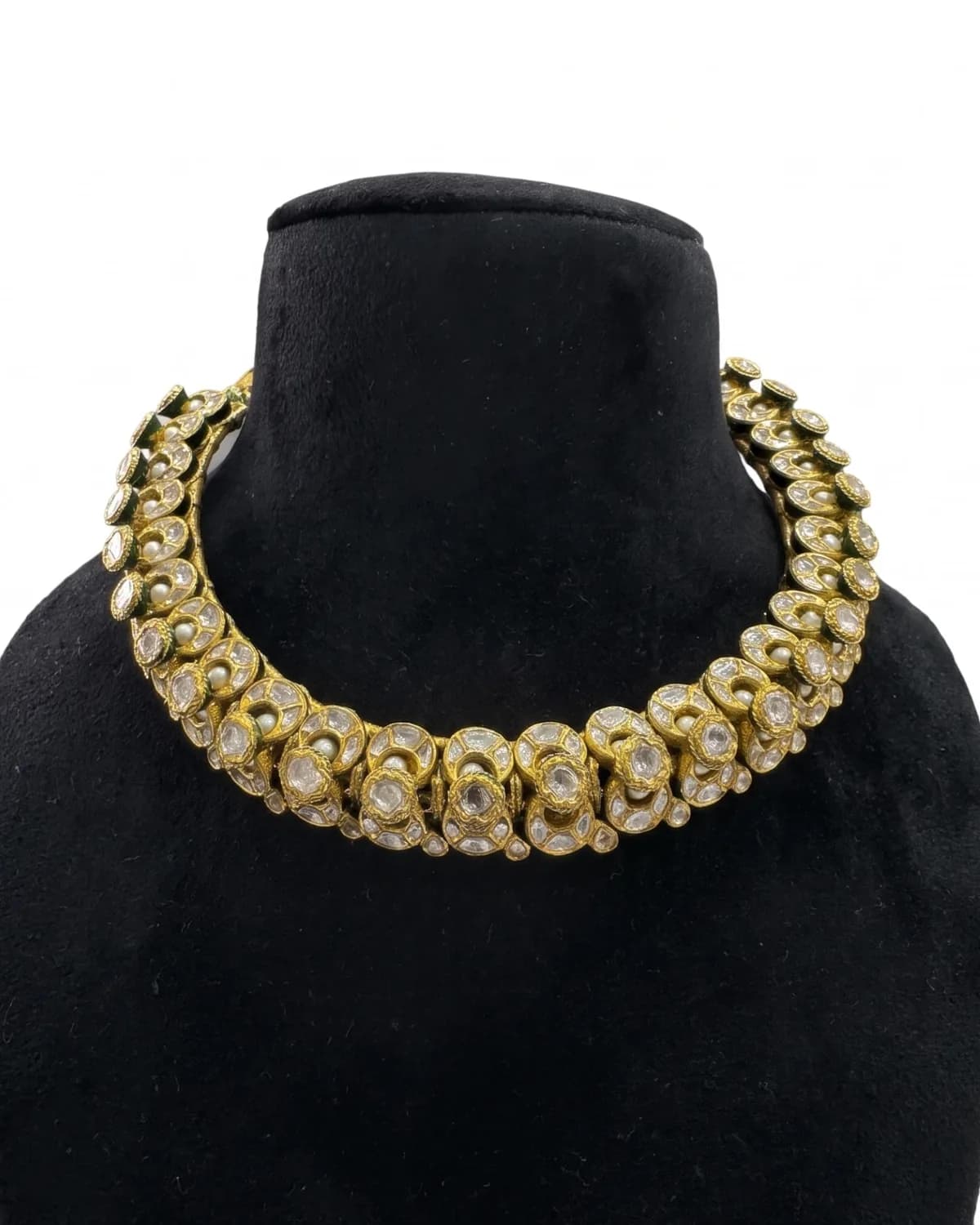
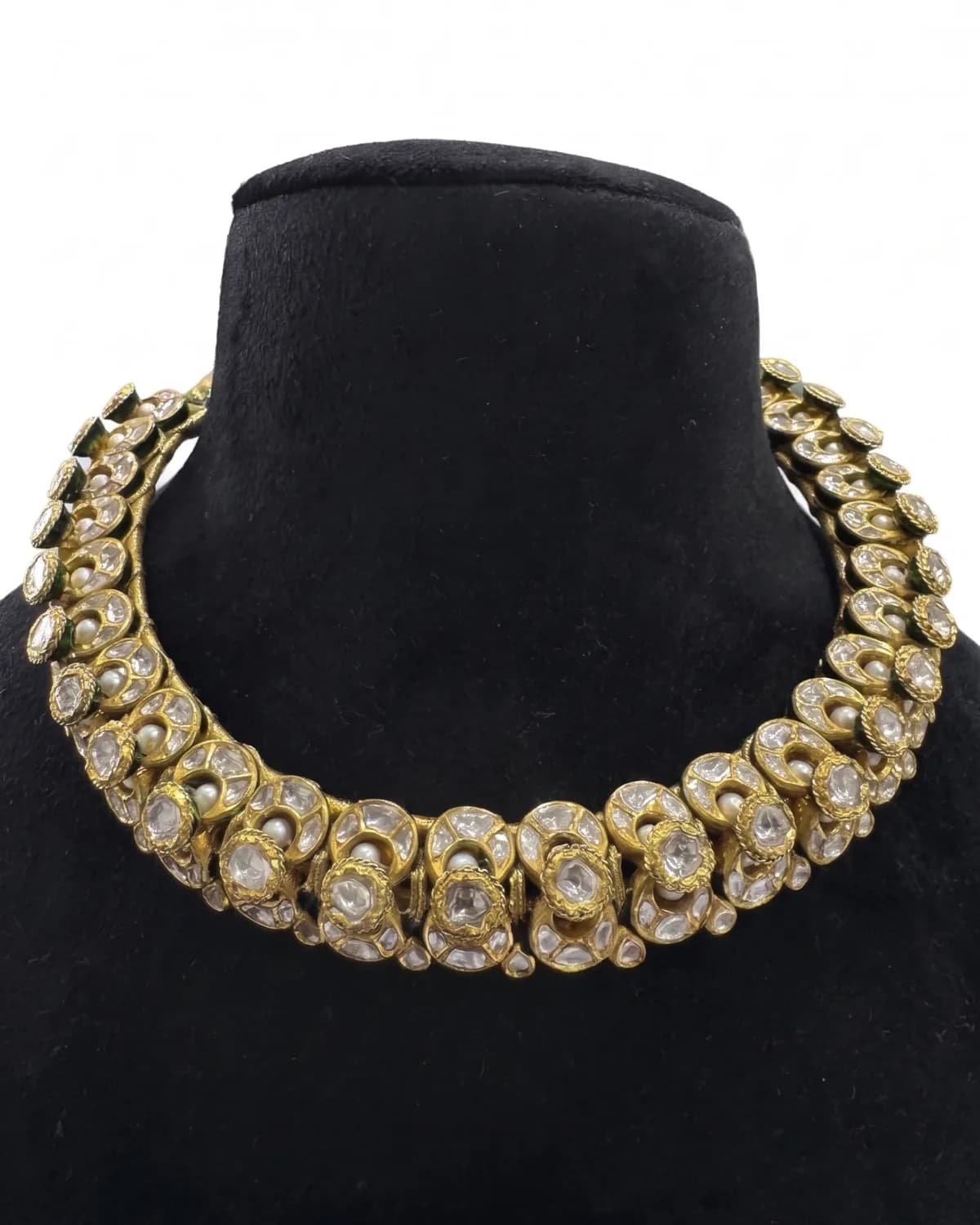
The gold hasli necklace is the rigid Rajputi collar worn on the collarbone — and, with the ponchi, the piece we are known for. Each one is handcrafted in kundan meena jadau work, in 18K or 22K gold, one piece at a time, so every hasli has a look of its own. The price breakup is shared on WhatsApp.
One of our two specialities
Rajputi Gold Hasli
The second of the two pieces people know us for. Each gold hasli necklace leaves the bench as a single piece of handcrafted kundan meena — the anchor of a Rajasthani bridal look, for brides across India and NRI families.
What is a gold hasli necklace?
A gold hasli necklace — हसली, also written hansuli or hasuli, from hansli, the collarbone — is a rigid gold collar that rests on the collarbone instead of hanging from a chain. It holds its own shape and usually opens at the back, and in Rajasthan it is made plain or set with stones in kundan and meena.
- rests on the collarbone, keeps its shape
- Rigidrests on the collarbone, keeps its shape
- on one karigar’s bench
- 15–20 dayson one karigar’s bench
- deeper yellow, or a stiffer collar
- 22K or 18Kdeeper yellow, or a stiffer collar
- the weight on every piece’s page
- Gold alonethe weight on every piece’s page
How we make a gold hasli
Worked on one karigar's bench at a time, from drawing to polish.
Drawing
Every hasli starts as a drawing, sized to the neck it will sit on.
Meenaमीना
The meena colours are fired into the gold first — the lac that comes next could not take the kiln’s heat.
Jadaiजड़ाई
Every stone and polki is pressed in with kundan over a bed of lac, which gives the kundan its grip.
Polish
Finished, checked against the drawing and weighed for its gold alone.
Gold hasli for brides
- It sits at the base of the neck and frames everything below it.
- Pair it with a pair of gold ponchi — the two pieces our house is known for.
- Send us the wedding date and a neck measurement first.
- Allow 15 to 20 days on the bench.
What does hasli mean?
Hasli (हसली) comes from hansli, the Hindi word for the collarbone — the bone the necklace rests on. You will also see it written hansuli or hasuli. A hasli is simply a rigid collar of gold or silver worn at the base of the neck.
What is the difference between a hasli, an aad and a timaniya?
A hasli is one rigid collar that holds its own shape. An aad is a broad plate of hinged panels across the throat, tied with a cord at the back. A timaniya is a short strand with a central motif, often worn under a hasli. All three sit at the throat, but they are made — and priced — differently.
Is a hasli the same as a choker?
Not quite. A choker is any necklace worn close to the throat, and most are flexible. A hasli is rigid: it rests on the collarbone and keeps its shape, so it sits the same way on everyone who wears it.
Will a hasli bend out of shape?
Not with ordinary care — it is rigid by design. An 18K hasli is the stiffer of the two, so a slim collar holds its curve better; a 22K one has the richer yellow and is the traditional choice. Store it on its own, never under heavier pieces. Each carries a BIS hallmark.
Is a hasli heavy to wear?
Lighter than it looks, because it rests on the collarbone instead of hanging from the neck — the weight sits on bone, not on the throat. Its gold depends on its width and its stones, so every hasli's own page gives its gold weight, with the stones and the lac beneath them weighed separately and left out.
Where should a hasli sit on the neck?
On the collarbone, never pressing against the throat. To get it there, measure around the base of the neck, where a collar would rest, and send us the number — or send a necklace that already sits right.