Jewellery guide
Thewa Jewellery: Pratapgarh’s Gold-on-Glass Art
A sheet of 23-karat gold, pierced by hand into a whole scene and fused onto molten glass with no glue. How thewa is made, what it costs, and how to tell the real thing.
By Ponchi by MK Jewellers, Jaipur8 min read
Key takeaways
- Thewa is 23K gold, pierced by hand into a scene and fused onto coloured glass without glue — a closed family craft of Pratapgarh.
- Real thewa was listed online from about ₹9,000 for a ring to around ₹2 lakh for a bridal set (October 2026).
- Imitation thewa is printed or glued gold-coloured foil. Real gold sits flush in the glass, with crisp hand-cut edges.
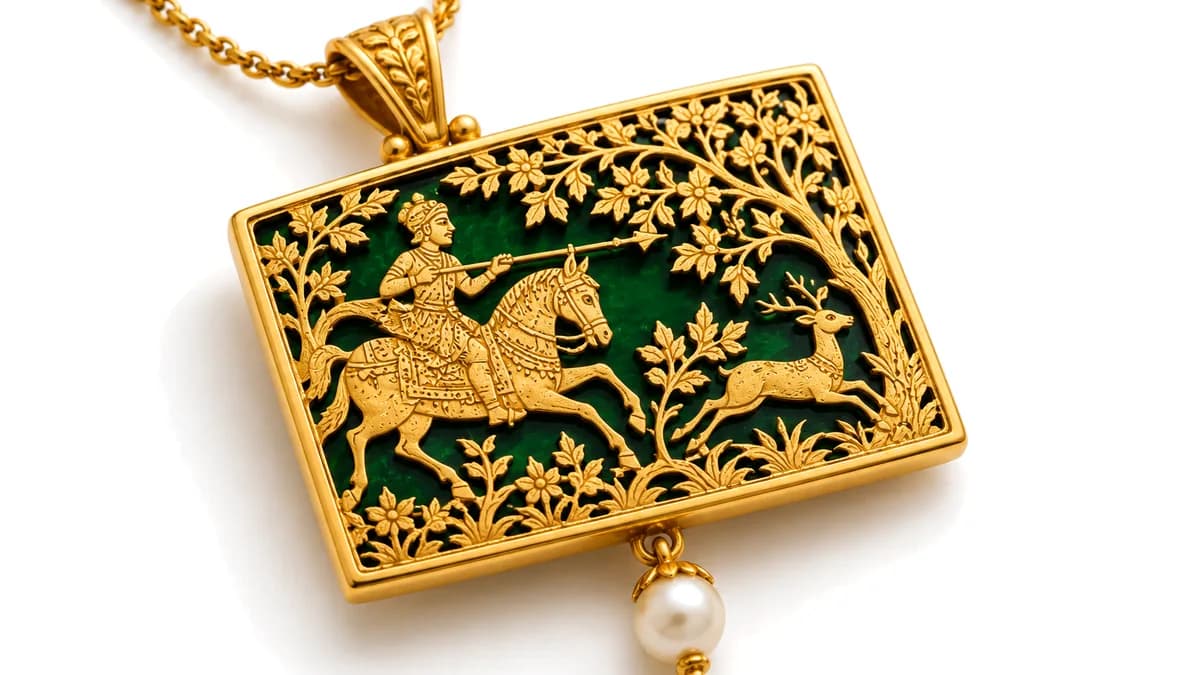
Thewa jewellery is a craft from Pratapgarh, Rajasthan, in which a sheet of 23-karat gold is hammered thin, pierced by hand into a detailed scene and fused onto coloured glass without any adhesive. Most pieces are deep green, red or blue glass set in a gold or silver frame. It has been a closed family craft for about three centuries.
What is thewa jewellery?
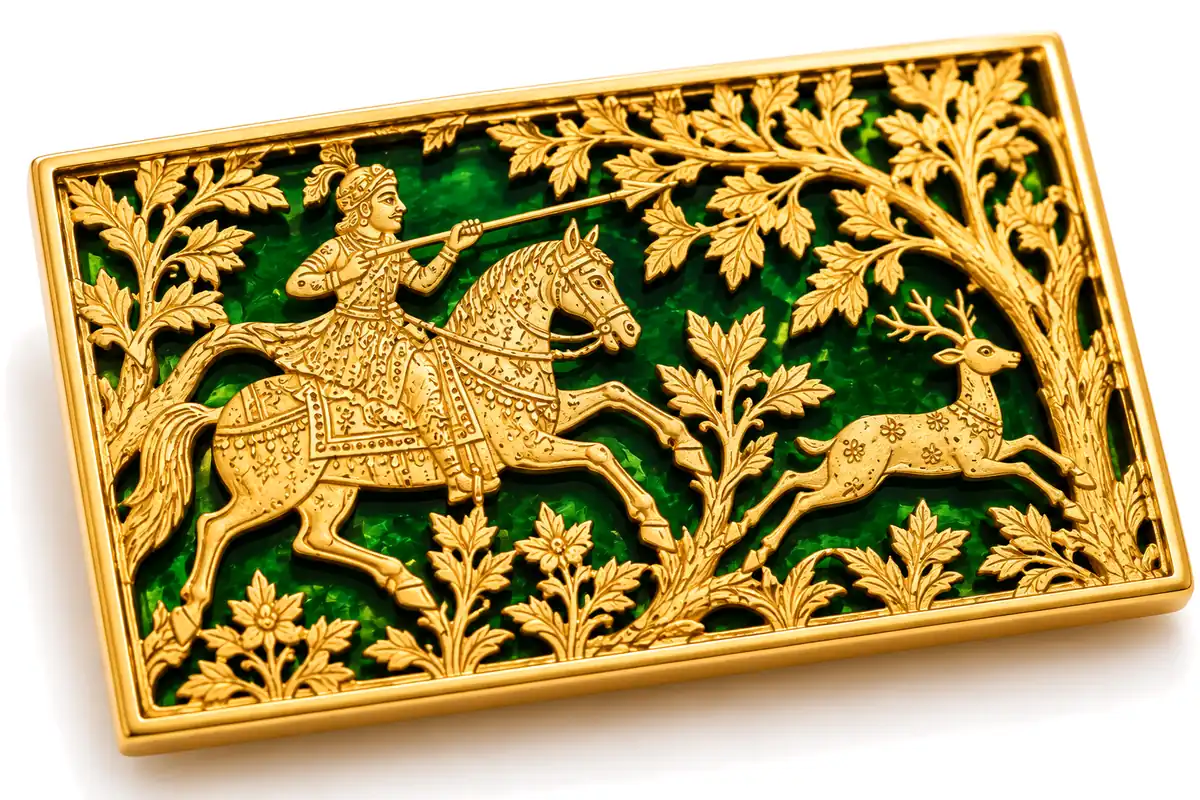
Thewa is gold drawing on glass. A goldsmith takes a sheet of 23-karat gold, hammers it until it is barely there, and cuts a complete picture into it by hand — a hunt, a royal procession, Krishna with the gopis, a peacock in a garden. That gold picture is then fused directly onto a piece of coloured glass, so the scene seems to float on the colour. No adhesive is used. How the bond is made is the part that has never been written down.
Thewa comes from Pratapgarh, in southern Rajasthan, and from almost nowhere else. It has been a closed family craft there for roughly three centuries, passed down inside the Soni goldsmith line and taught to almost nobody outside it. Today about a dozen families still know how.
Where thewa comes from
Thewa was born at the Pratapgarh court around the late seventeenth or early eighteenth century, as a way of making gold pictures that would last — gold does not tarnish, and glass does not fade. Pieces were made as pendants, boxes, plates and ornaments for the court, and the subjects were the ones a Rajput court cared about: hunting, war, processions, gods and love stories.
Because the knowledge stayed inside a few families, thewa never industrialised. That is both its value and its risk: there is no factory version of real thewa, and there are fewer hands making it every decade. A name can be protected; knowledge has to be passed on.
How is thewa jewellery made?
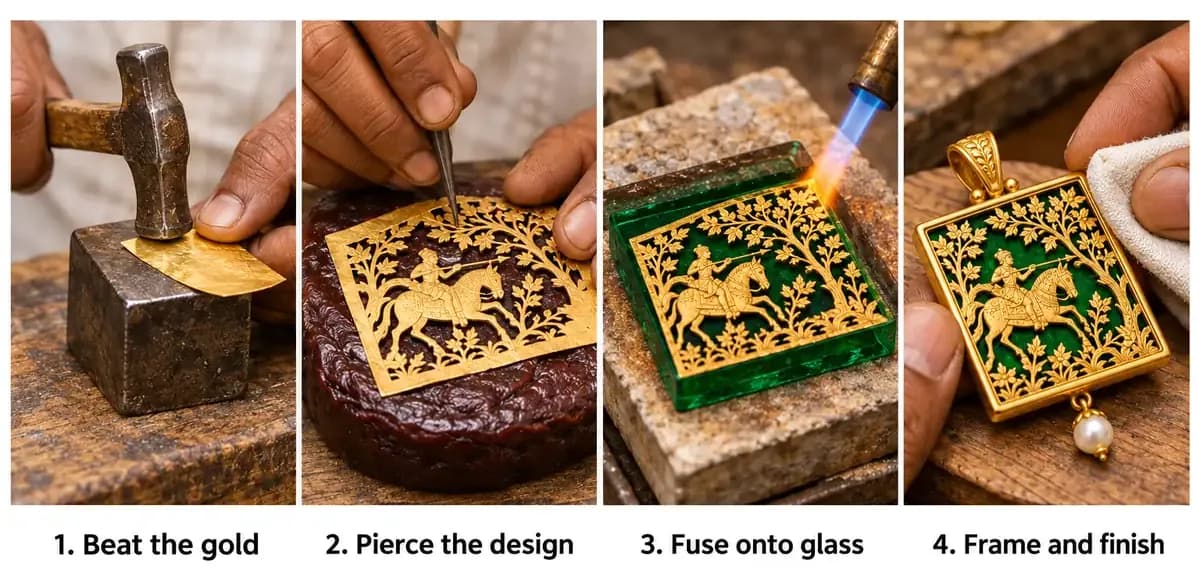
- The gold is beaten thin. A small sheet of 23K gold is hammered until it is almost foil. 23K, because the gold must be soft enough to cut finely and pure enough to fuse.
- The scene is pierced by hand. The sheet is laid on a lac-covered board to hold it still, and the design is cut and engraved into it with fine chisels — every horse, every leaf, every line. The background is cut away, leaving an openwork gold picture.
- The gold is fused onto the glass. Coloured glass is shaped to the piece, and the gold picture is bonded to it with heat. This is the family secret: done wrong, the glass cracks or the gold lifts.
- The piece is framed and finished. The glass is set in a gold or silver frame, polished, and made into a pendant, earrings, a bangle or part of a necklace.
A single detailed scene can take an artisan days, which is why thewa is priced by the piece and the work, not only by its gold.
Thewa designs and what they show
- Shikar (the hunt) — riders, deer, tigers and dogs. The classic thewa subject.
- Processions — elephants with howdahs, horsemen and royal parades.
- Krishna and the gopis, Radha–Krishna and other scenes from Hindu stories.
- Bani Thani and court portraits, borrowed from Rajasthani miniature painting.
- Peacocks, elephants, flowers and trees — the motifs most often used for smaller pieces and earrings.
The more figures in a scene, and the finer the lines between them, the more skill — and the more days — a piece represents.
Thewa colours: green, red and blue
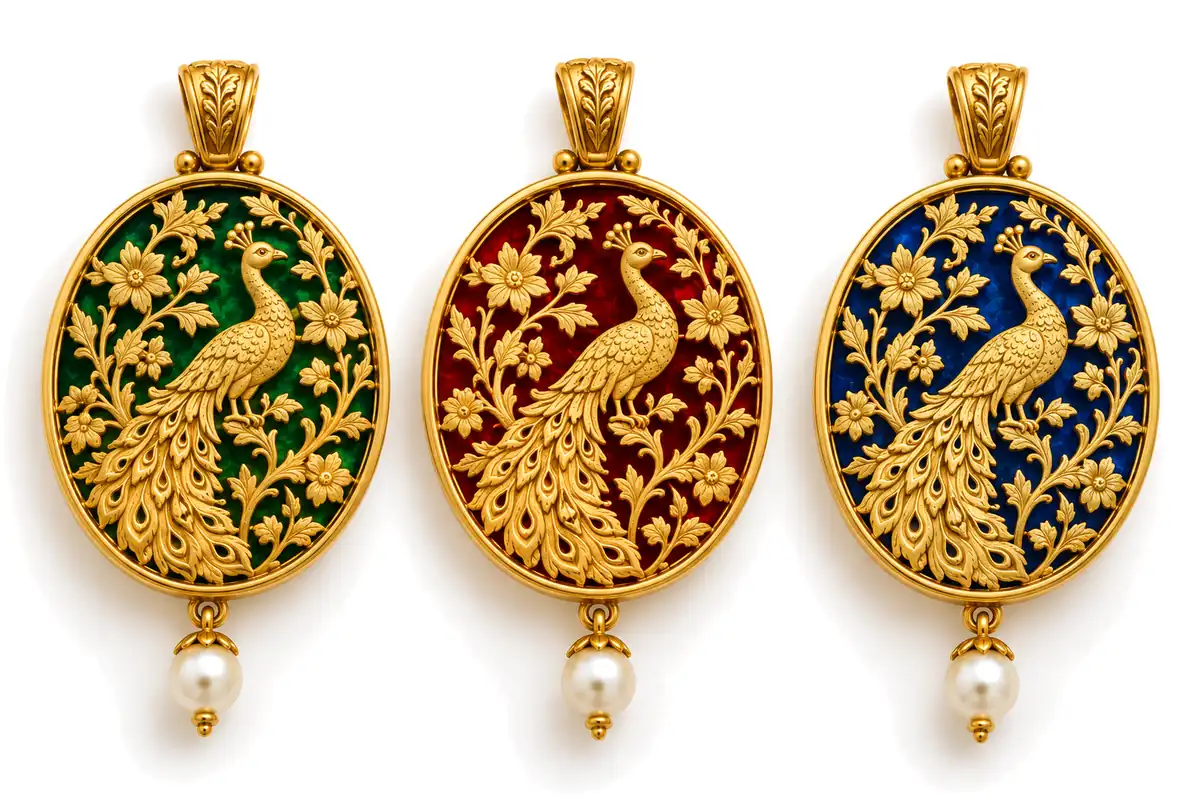
Thewa is made on three classic colours of glass: deep green, the most traditional and the one most people picture; red, the bridal favourite; and blue. The colour sits behind the gold like a stained-glass window, so the same scene reads very differently on each. Some pieces are also framed with pearls or small coloured stones.
Thewa vs meenakari: two ways to put colour in gold
Thewa and meenakari both pair gold with colour, and people often mistake one for the other in photographs. They are opposite techniques.
| Thewa | Meenakari | |
|---|---|---|
| Where the colour comes from | A piece of coloured glass under the gold | Powdered glass enamel fired into the gold |
| Where the gold is | On top: a pierced 23K sheet fused to the glass | Around: engraved 22K walls holding each colour |
| What you see | A gold picture floating on one colour | Many colours, outlined in thin gold lines |
| Made in | Pratapgarh, by a few families | Jaipur, in many workshops |
| Usually seen on | Pendants, earrings, boxes | The back of kundan pieces, bangles, jhumkas |
So a thewa piece is a gold drawing on glass, while meenakari is enamel painting inside gold. To see meenakari at its best, turn over a kundan piece — that guide also explains why red is always fired last.
Wearing thewa: what to buy first
- A pendant — the classic first thewa piece: one complete scene, easy to wear with Indian and Western clothes alike.
- Earrings — usually small motifs (a peacock, an elephant, a flower) rather than full scenes, and light enough to wear often.
- A bridal set — thewa necklaces with pearls are made for weddings and look very different from the kundan and polki sets around them.
- A gift — because every scene is cut by hand, a thewa piece is one of the few jewellery gifts that is genuinely one of a kind.
What does thewa jewellery cost?
Thewa is priced on three things: the gold (the 23K work and any gold frame), the size and detail of the scene, and the maker. In online listings we checked in October 2026, real thewa ranged from about ₹9,000 for a small ring and ₹11,000–₹20,000 for a pendant to ₹17,000–₹1,40,000 for necklaces and around ₹2,00,000 for a bridal set.
How to tell real thewa from imitation
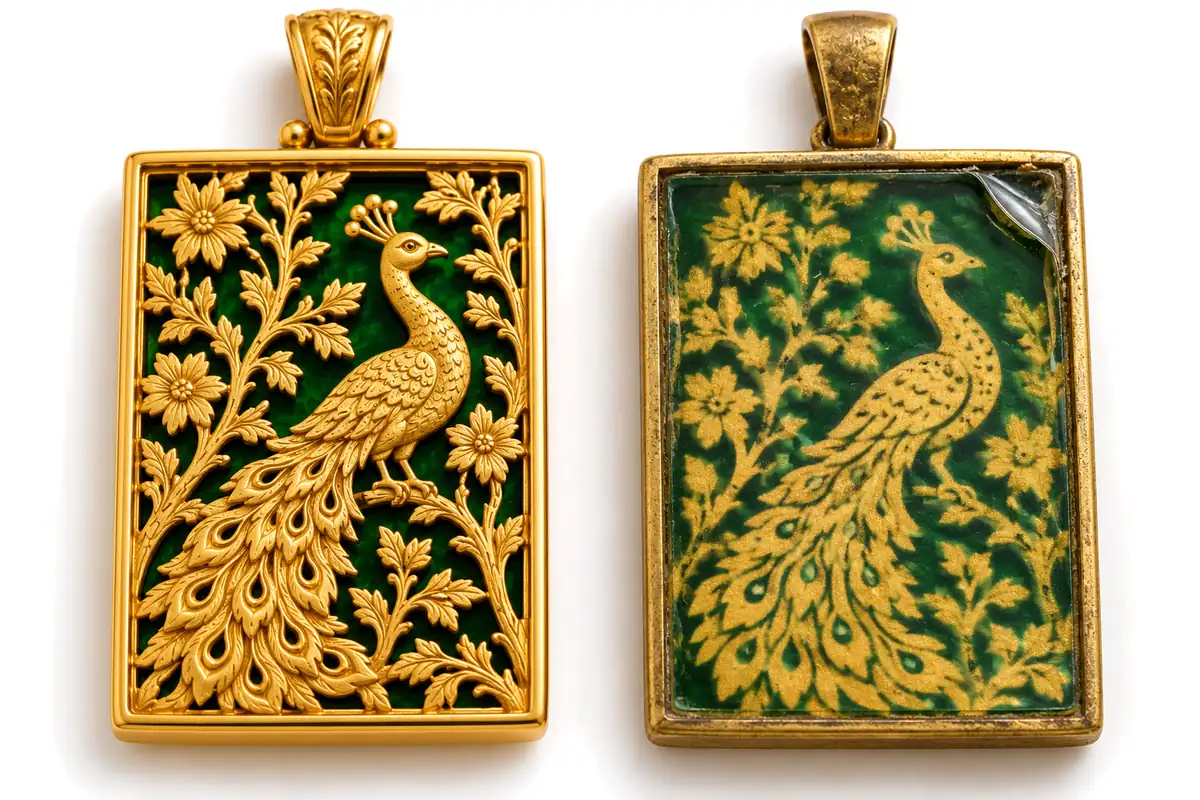
- Look at the edges of the gold under a loupe. Hand-pierced gold has crisp, slightly irregular cut edges and real depth. A print is flat and blurs at the edges.
- Check that the gold sits flush. Fused gold is part of the glass. Glued foil shows a glue line, lifts at a corner, or catches a fingernail.
- Ask for the hallmark on the gold frame, and the purity of the gold work.
- Ask who made it. Real thewa comes from Pratapgarh artisans; a seller of the real thing will tell you which workshop.
- Be suspicious of a low price. A detailed scene takes days. If it costs less than a day’s work, it isn’t thewa.
Where to find thewa jewellery in Jaipur
Thewa is made in Pratapgarh but sold widely in Jaipur, where most buyers first see it. Wherever you buy, ask the questions above, and ask for the gold to be itemised on the bill.
Our thewa is green glass in a gold frame, and we can commission thewa pieces from Pratapgarh to your design. You are welcome to visit our Jaipur shop to see thewa next to kundan and polki work — it is the clearest way to understand how different the three crafts are. For the wider family of Rajasthani pieces, see Rajasthani jewellery names.
Caring for thewa jewellery
- It is glass: avoid knocks. Take thewa off before anything physical, and never drop it on a hard floor.
- Store it on its own, wrapped in soft cloth, so harder jewellery cannot scratch the gold or the glass.
- Wipe with a soft dry cloth. No chemicals, no ultrasonic cleaners, no soaking.
- Keep it away from sudden heat — glass and gold expand differently.
Questions people ask
What is thewa jewellery?
Thewa is a jewellery craft from Pratapgarh, Rajasthan, in which a thin sheet of 23-karat gold is pierced by hand into a detailed scene and fused onto coloured glass without adhesive.
How is thewa jewellery made?
A sheet of 23K gold is hammered thin, a design is cut into it by hand on a lac board, the openwork gold is fused onto coloured glass with heat, and the piece is set in a gold or silver frame. The fusing method is a family secret.
What is the price of thewa jewellery?
In October 2026, real thewa was listed online from about 9,000 rupees for a ring and 11,000 to 20,000 rupees for a pendant, up to more than one lakh for necklaces and about two lakh for a bridal set.
Is thewa jewellery real gold?
Real thewa is made with 23-karat gold work, usually in a gold or silver frame. Cheap imitation thewa uses gold-coloured foil or print on glass or resin.
Where is thewa jewellery made?
In Pratapgarh, in southern Rajasthan, by a small number of goldsmith families of the Soni line. It is sold widely in Jaipur.
Which colours does thewa come in?
Traditionally deep green, red and blue glass, with the gold scene fused on top.