Jewellery guide
Polki Jewellery: Meaning, Making & Buying Guide
Polki is a real diamond that was never faceted. What that means for how it looks, how it is set, what it costs — and the eight questions to ask before you buy.
By Ponchi by MK Jewellers, Jaipur9 min read
Key takeaways
- Polki is a natural diamond split along its own planes and never faceted — flat underneath, domed on top, so it glows rather than sparkles.
- Most polki is set closed, with silver foil behind the stone. Open settings need cleaner stones and cost more.
- Real polki is sold by the carat, ideally with a lab report. Ask for diamond weight and net gold weight as separate lines on the bill.
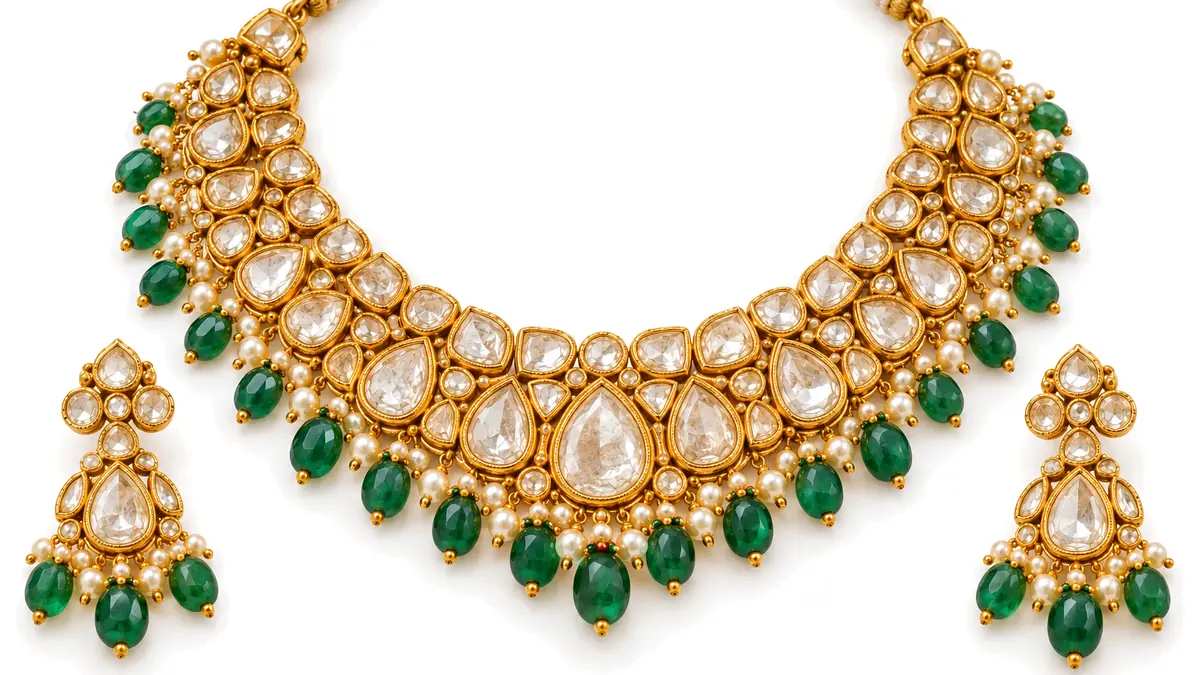
Polki jewellery is jewellery set with polki — natural diamonds that are split along their own planes and lightly polished, but never faceted. Flat underneath and gently domed on top, a polki glows rather than sparkles. It is usually set in gold by the kundan method, with a thin silver foil behind it to throw light back through the stone.
Polki jewellery meaning: what is a polki?
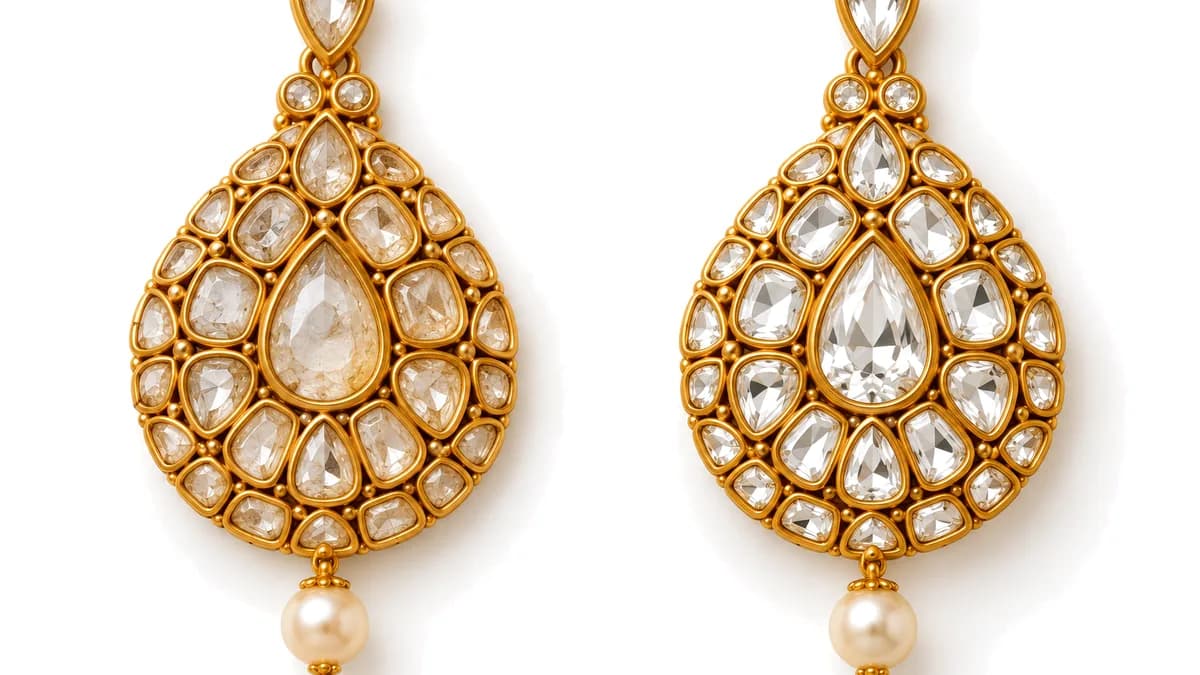
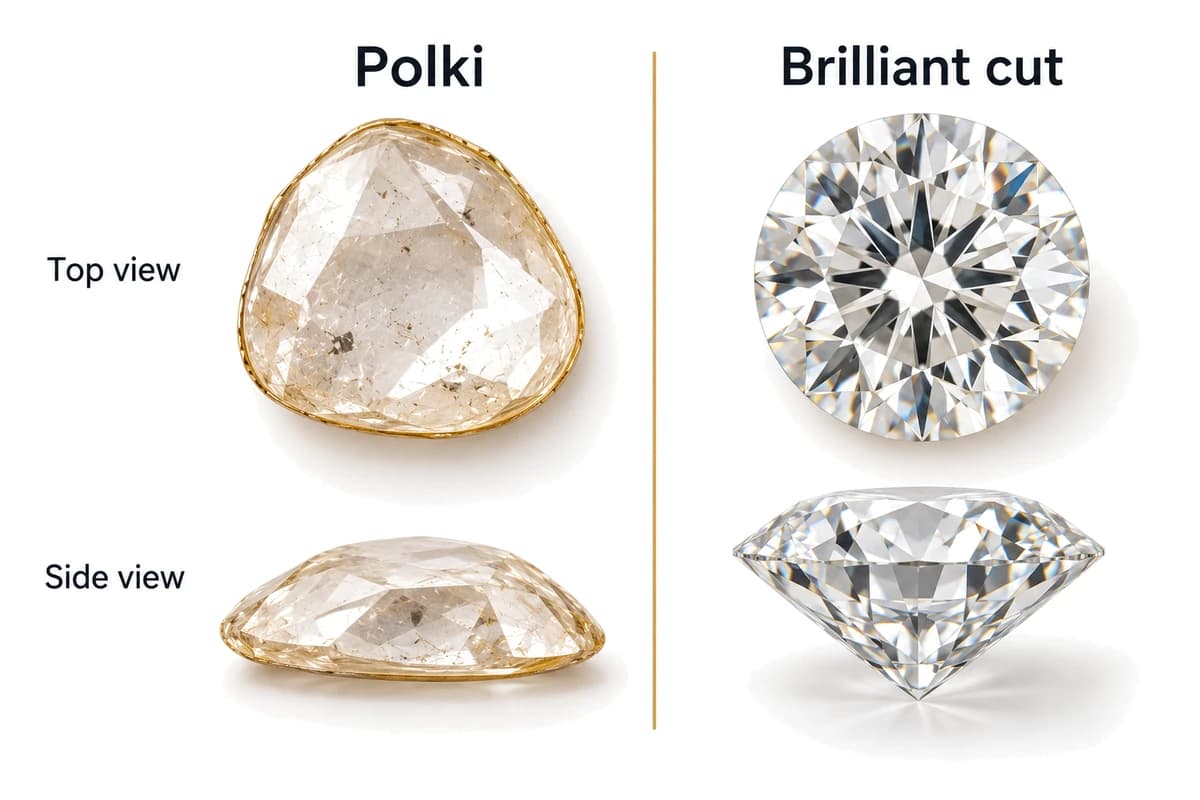
A polki is a diamond in its natural form. Instead of being sawn and ground into 57 or 58 mirror-like facets, the rough crystal is split along its own natural planes, polished just enough to show its face, and left flat on the bottom and softly domed on top. Nothing about it is imitation: it is the same carbon crystal as any solitaire, simply cut the way diamonds were cut in India for centuries — before the brilliant cut existed.
That is why polki glows instead of sparkling. A brilliant-cut diamond is engineered to bounce light back out of its top in flashes. A polki lets light in and gives it back softly, with the warmth of the gold around it. Diamond behaving like diamond, before Antwerp got to it.
Polki, kundan and jadau are not the same thing
Polki is the stone. Kundan is the gold foil setting that holds it. Jadau is the whole craft — frame, lac, setting and enamel. So most polki jewellery is, technically, polki set in kundan, made in the jadau tradition. If you have been comparing polki and kundan as if they were rivals, read the difference between polki and kundan — it is shorter than you think.
A short history: India’s first diamonds
For most of history, India was where the world’s diamonds came from — the Golconda mines of the Deccan supplied the courts of Asia and Europe until new sources were found in Brazil in the eighteenth century. Indian jewellers had no reason to grind away a stone’s weight to chase sparkle; they valued size, colour and the stone’s own shape, and set it flat against gold so the whole face showed.
That is the polki tradition. It was worn by Mughal emperors and Rajput queens alike, and it survived the arrival of the brilliant cut because it does something faceting cannot: it makes a large, warm, almost liquid surface out of a diamond that might otherwise lose half its weight in cutting.
How polki is set in gold
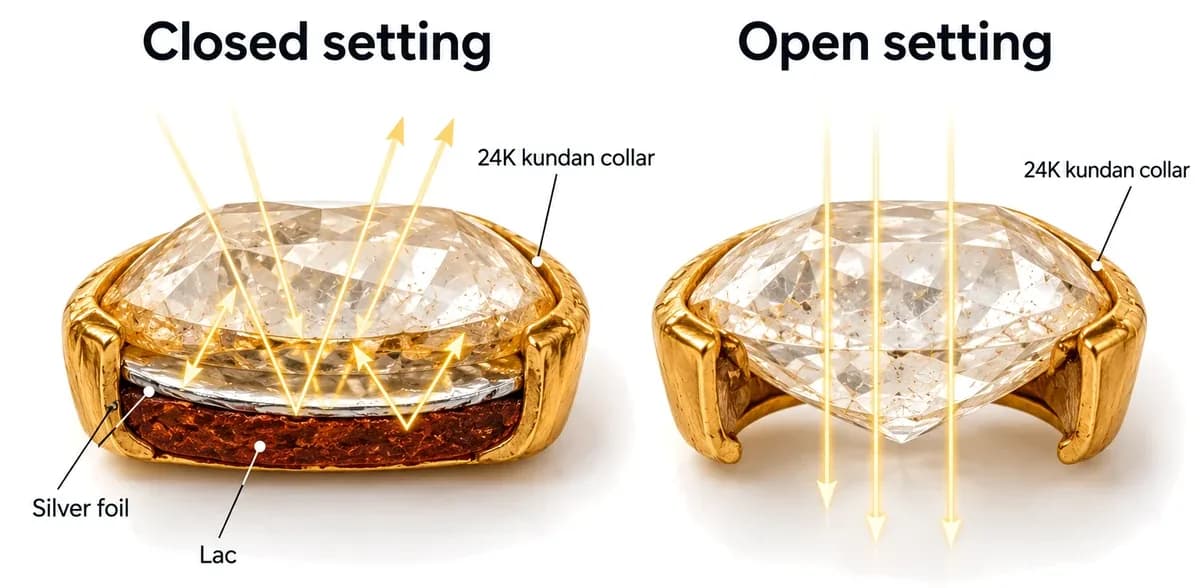
Polki is set by the same relay that makes all jadau work: a gold frame is carved with one cavity per stone, the back is enamelled and fired, the hollows are filled with warm lac, and the polki is bedded into the lac and gripped by a collar of 24K kundan foil. What changes with polki is the light.
Closed setting (with foil)
Most polki is set closed. A sliver of silver foil — panni — sits behind each stone and throws the light back up through it, which is how a thin, flat diamond can look bright. It is also why moisture is polki’s enemy: once water gets behind the foil it tarnishes and the stone goes dull from behind.
Open setting (no foil)
Higher-grade polki is sometimes set open, with the back of the gold cut away so light passes straight through. Only clean, well-coloured stones can stand being seen this way, so an open setting is usually a sign of better polki — and a higher price.
Are polki diamonds real or fake?
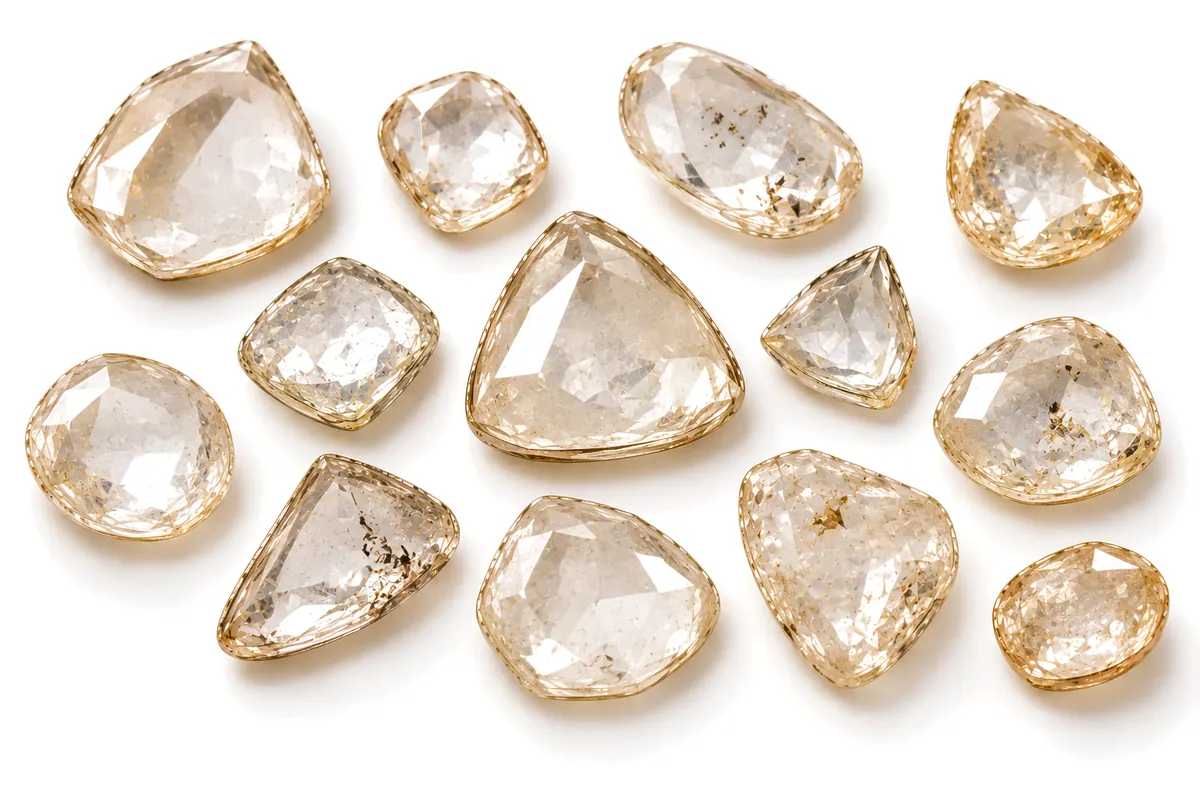
A true polki is a natural diamond — no more fake than a solitaire. The problem is the word. “Polki” is also used to sell uncut moissanite, glass and CZ cut flat to look like polki, set in gold-plated metal. Those are polki-look jewellery, and they are priced like it.
How to tell the difference:
- Ask for the carat weight. Real polki is sold by the carat. If the bill shows no diamond weight, there may be no diamond.
- Ask for a lab report. Independent gem labs grade polki and uncut diamonds; a precious piece should arrive with paper.
- Look through a 10× loupe. Natural diamond shows crystal inclusions and an irregular outline. Glass shows round gas bubbles and swirl marks.
- Don’t trust a pen tester alone. Moissanite passes many thermal “diamond testers”. Only an electrical tester or a lab separates the two.
- Check the hallmark. Real polki is set in hallmarked gold, with a 6-digit HUID.
How much does real polki cost? What decides the price
Polki jewellery has two separate price lines that people tend to blur: the diamonds and the gold. Is polki more expensive than gold? Gram for gram, yes — you are paying for the gold and for natural diamonds on top of it.
| What decides it | Why it matters | What to ask |
|---|---|---|
| Carat weight | Polki is priced per carat | Total diamond weight, on the bill |
| Colour & clarity | Whiter, cleaner polki costs more | The grade or the lab report |
| Size of each stone | Large single polki cost far more per carat than small ones | The size of the biggest stones |
| Setting | Open setting needs better stones | Open or closed? |
| Net gold weight | Follows the daily gold rate | Net weight, lac excluded |
| Making | Five hands and a kiln | Making as a separate line |
That is why two polki sets of the same size can be lakhs apart, and why a polki set priced like costume jewellery almost certainly isn’t polki. For today’s rate, see the 22ct gold price today.
Polki vs diamond: which should you choose?
| Polki | Brilliant-cut diamond | |
|---|---|---|
| Cut | Split and polished, no facets | 57–58 machine-cut facets |
| Look | Soft glow, large flat face | Bright flashes of light |
| Setting | Kundan foil in a jadau frame | Prongs or bezel, usually 18K |
| Feels like | Heritage, bridal, heirloom | Modern, everyday |
| Best for | Aad, choker, kada, bridal sets | Rings, studs, tennis bracelets |
Neither is “better”. If you want a piece that reads as Rajasthani from across a room, polki. If you want sparkle for daily wear, a cut diamond.
Buying polki jewellery: 8 questions to ask
- What is the total diamond weight in carats?
- Is there a lab report for the polki?
- What is the net gold weight — with the lac taken out?
- Is the lac charged at the gold rate? (It shouldn’t be.)
- Open setting or closed?
- Where is the BIS hallmark and the HUID?
- What is your buyback or exchange policy for the diamonds — in writing?
- Who made it, and can it be repaired or restrung by the same workshop?
Popular polki jewellery pieces
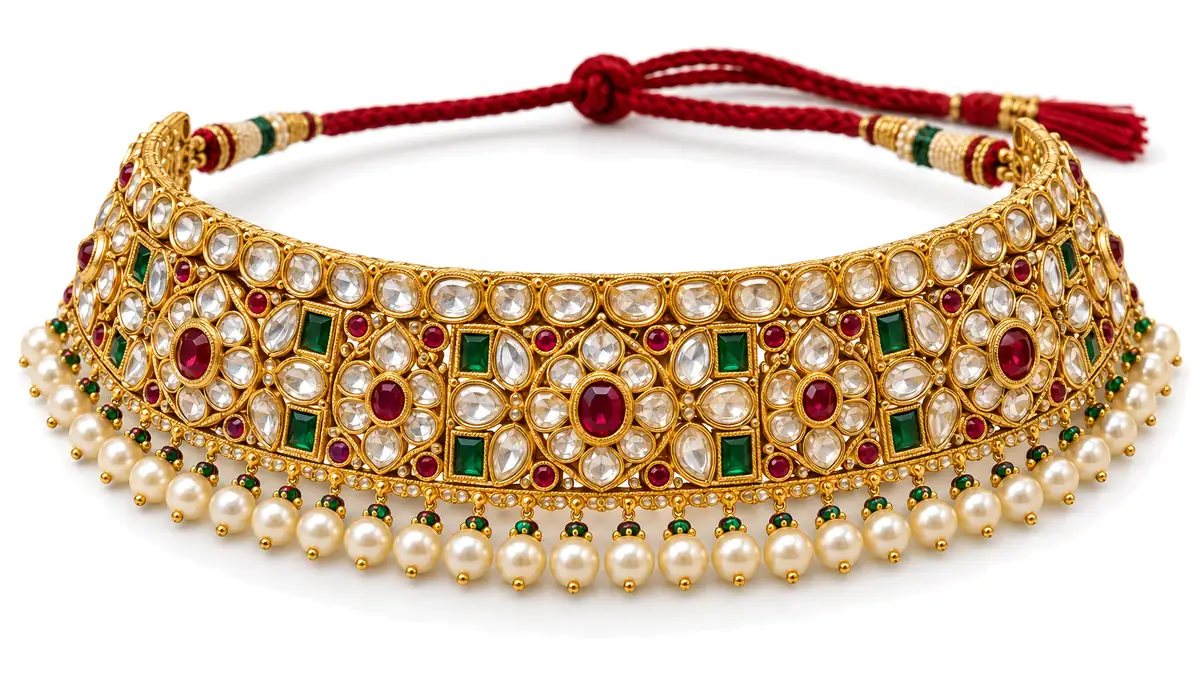
- Polki choker and aad — the broad Rajputi plate necklace, where polki looks most at home. See our gold choker necklaces.
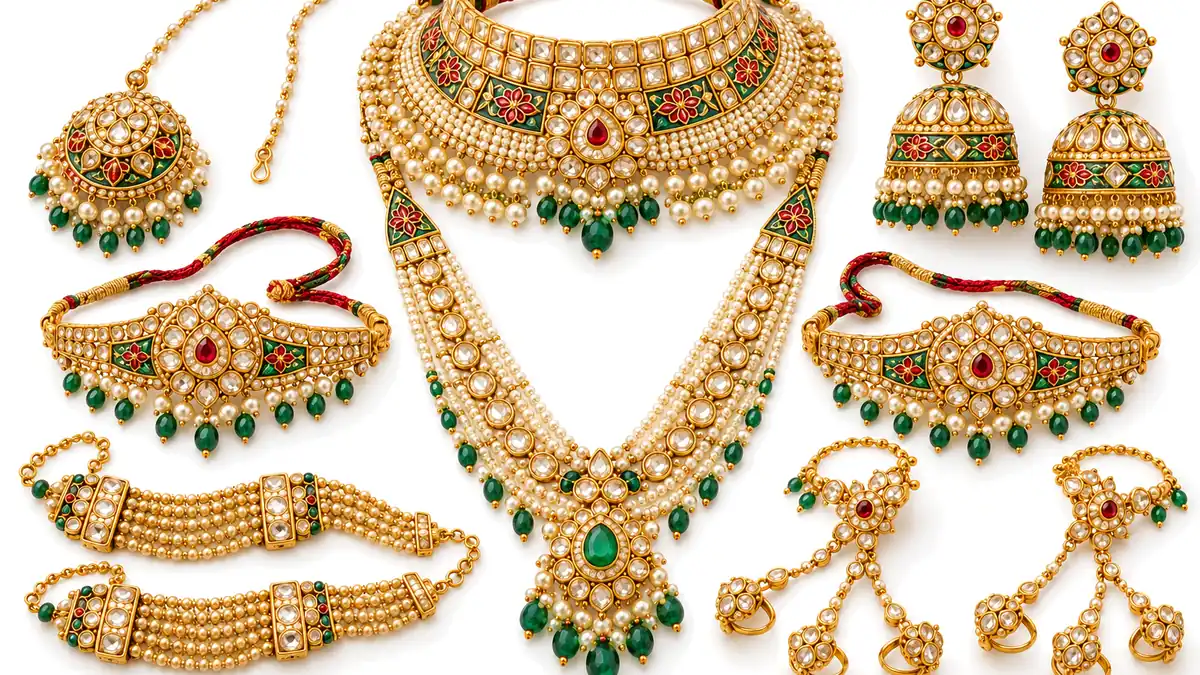
- Polki jewellery set — necklace, earrings and maang tikka made as one; the most searched form of polki.
- Polki kada and bracelet — a single rigid band of polki that can be worn far beyond the wedding. See our gold polki bracelets.
- Polki earrings — chandbalis and jhumkas, often with emerald or ruby drops.
- Polki rings — a flat polki cluster on a broad band.
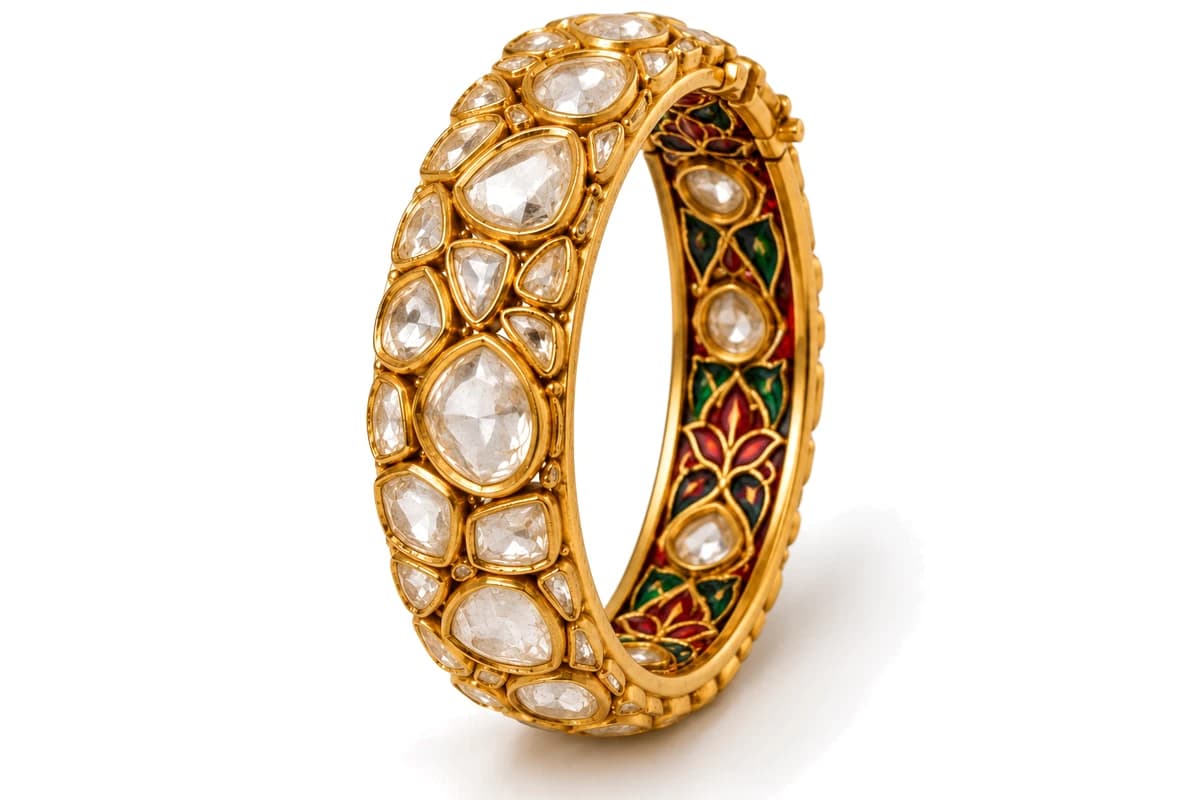
Old polki: resetting a family piece
Diamonds do not wear out, which is why so much polki is inherited. A grandmother’s set whose design no longer suits can be taken apart and its polki reset into something new — the gold reused or exchanged, the stones kept.
- Have the polki counted and weighed before anything is opened, and get the carat weight in writing.
- Ask for the gold to be weighed net, after the stones and lac come out — that is the only figure the gold exchange should use.
- Decide what stays: some families keep the meenakari plates or the central stone as they were.
- Check the count again when the new piece is delivered.
Not sure what an old piece is? Bring it to our Jaipur shop — we will tell you what it is, whether or not you buy anything.
Caring for polki jewellery
- No water, ever, on closed settings. Moisture behind the foil is what turns a bright polki grey.
- Perfume and lotion first, jewellery last.
- No ultrasonic or steam cleaning — the heat and vibration loosen the lac and the foil.
- Store pieces apart, wrapped in soft cloth: diamond scratches everything, including other diamonds.
- Get it checked once a year, especially kadas and rings that knock against things.
Questions people ask
What is polki jewellery?
Polki jewellery is jewellery set with polki, which are natural diamonds left uncut — split and lightly polished but never faceted. They are usually set in 22K gold with a 24K kundan foil collar.
Are polki diamonds real?
A true polki is a real, natural diamond. The word is also used for glass, CZ or uncut moissanite in polki-look jewellery, so ask for the carat weight and a lab report.
How much does real polki jewellery cost?
It depends on the total carat weight and grade of the polki, the net gold weight and the making. Two sets of the same size can differ by lakhs, which is why the diamonds and gold should be separate lines on the bill.
Is polki cheaper than a cut diamond?
Often per carat, because polki is frequently cut from stones that would lose too much weight being faceted. A large, clean, well-coloured polki is not cheap.
Does polki jewellery have resale value?
The gold always does. Whether the diamonds are valued on resale depends on the jeweller's buyback policy, so ask for it in writing when you buy.