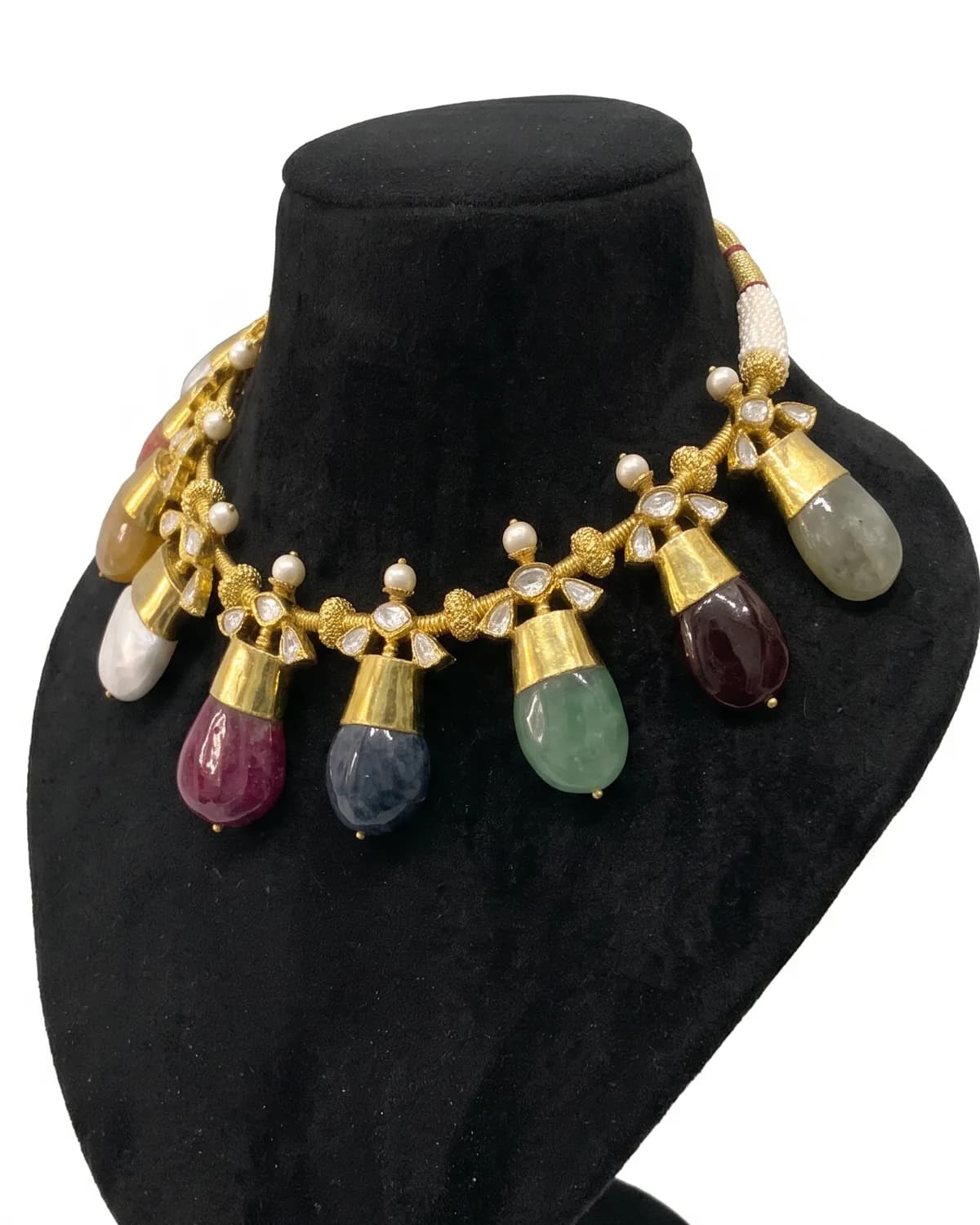
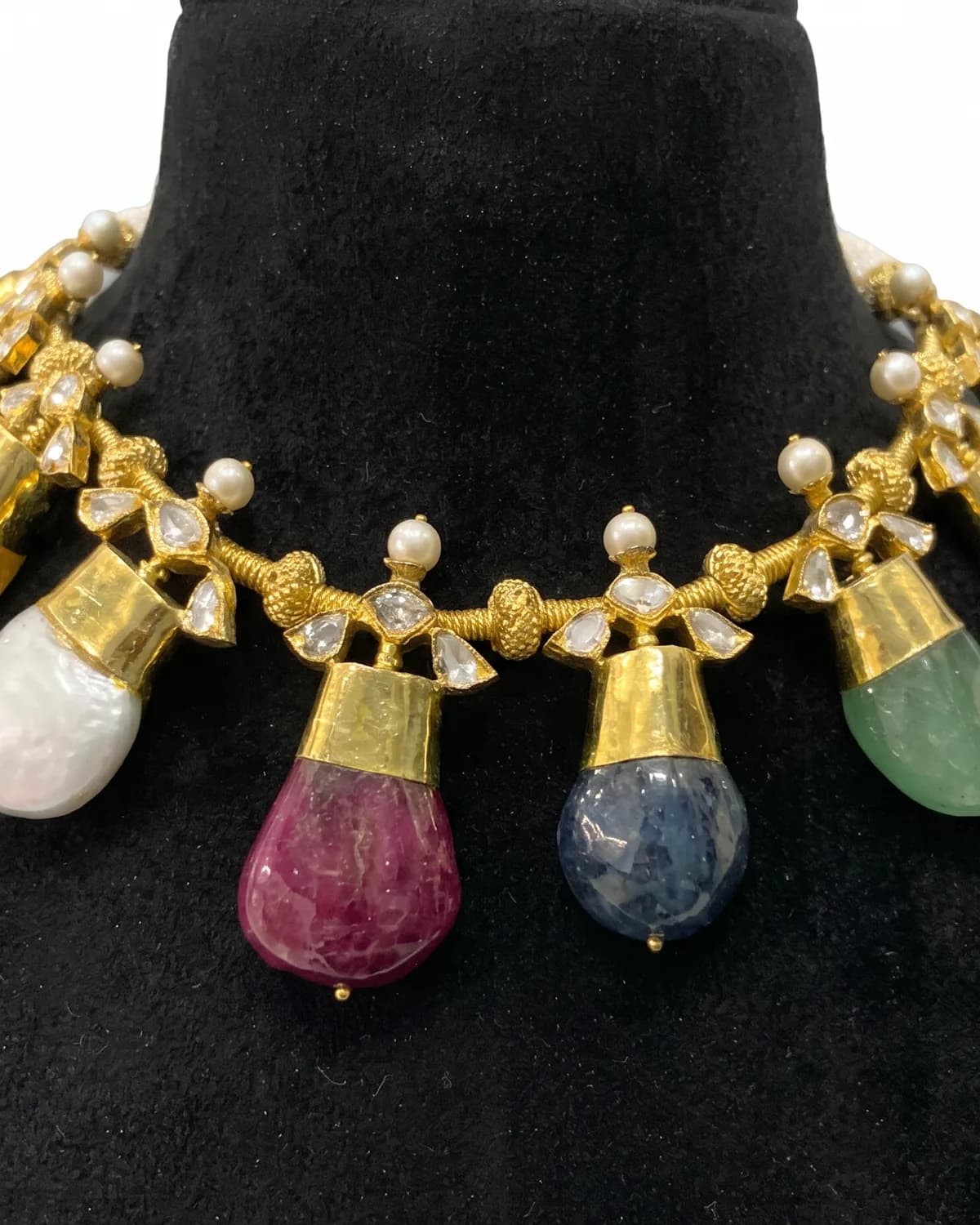
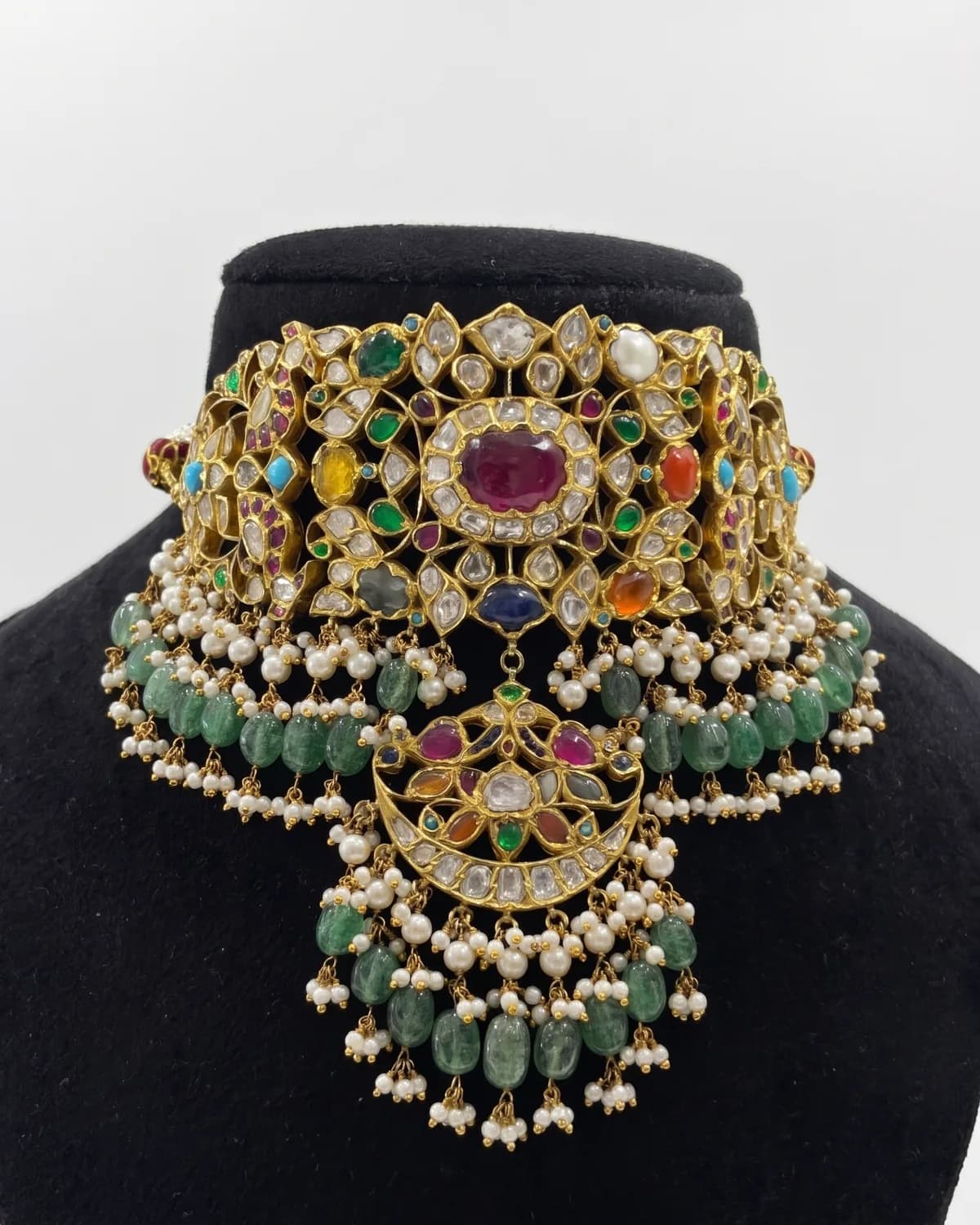
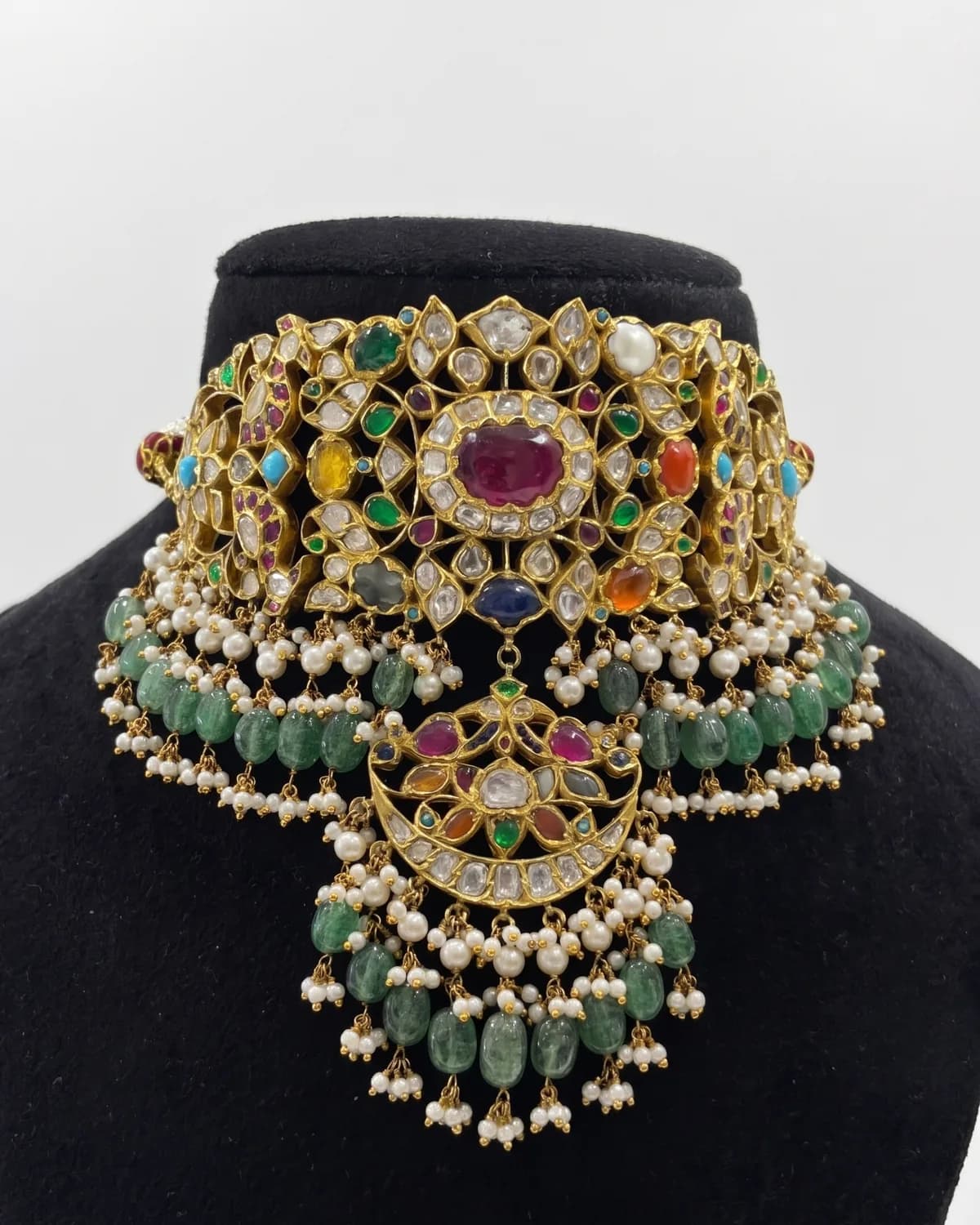
Navratan gold jewellery carries all nine planetary gemstones — the ruby for Surya at the centre and the eight grahas around it in one fixed order — set in 18K gold in our Jaipur workshop. Every stone is natural, cut to size and sent with a lab report, set open-backed to touch the skin or in kundan and jadau work: navratna necklace sets, bangles and the navratna ponchi, earrings, rings and the maang tikka. Each piece is made to order, with the price breakup shared on WhatsApp.
Who can wear navratna jewellery?
Traditionally, anyone. A single gemstone strengthens one graha, so it is matched to a horoscope first; navratna holds all nine in balance, which is why it has long been worn without a chart and given as a gift. Men wear it as a ring or bracelet; women as necklace sets, bangles, earrings and the maang tikka. If you wear it for astrological reasons, many families still ask their astrologer first — and so would we.
How can I tell if navratna stones are real?
Ask three things, in writing. Is each stone natural — not glass or lab-grown? Is it untreated — not heated or glass-filled to fake its clarity? And is there a lab report naming the stones, from a recognised laboratory such as Jaipur’s Gem Testing Laboratory? Sets sold as “navratna colours” are usually coloured glass or other stones in the nine shades. Treated and synthetic stones are fine as jewellery, but not as an astrological navratna. Every natural stone we set comes with a lab report you keep, and the gold carries a BIS hallmark with its six-digit HUID.
Are navratna stones measured in ratti or carat?
We size and price every stone in carats — the unit the lab report uses — and the size depends on the piece: larger stones for a necklace set, smaller ones for a ring or earrings, each cut to fit the design. If your astrologer gave you a weight in ratti, one ratti is roughly 0.9 carat, though sellers use slightly different ratti; tell us the figure and we will work it out in carats before the stones are cut.
Is navratna jewellery better in 22K or 18K gold?
Both are real gold, made for different work. 22K is 91.6% gold — softer, and richer in colour. 18K is 75% gold — harder, so it holds nine stones of different sizes firmly and keeps its shape in a ring or bangle worn every day, and it costs less per gram, which leaves more of the budget for the stones. We make our navratna in 18K (750), hallmarked by BIS with its HUID.
How much does navratan gold jewellery cost?
It is priced in parts: the net weight of gold at the day’s rate, the nine stones, the making, the hallmarking fee and 3% GST. The stones move the price most — natural, untreated rubies, sapphires and cat’s eyes cost many times what glass or treated stones do, so two pieces that look alike can be priced a hundred times apart. If you want the look for less, we can set processed stones instead and say so in writing. Check today’s gold rate, 18K included, and we will send the breakup for any navratna design on WhatsApp.
What is navratna jadau or kundan jewellery?
Navratna made the Jaipur way. The nine stones are held in a gold frame by kundan — a collar of 24K gold foil pressed around each stone — and the back is fired with meena enamel; together that is jadau. Because jadau closes the back of the setting, a jadau navratna is mainly worn as jewellery, often by brides; for astrological wear we set the stones open-backed so each one touches the skin. See how a jadau setting is built on our Jadau jewellery page.
What should I tell you when ordering a navratna piece?
Yes — every piece is. Choose a design here or send us a photo; the stones are cut to fit it, set in the traditional order, and the piece is sized to you — a ring to your finger, the navratna ponchi to your wrist. It takes 15 to 20 days. Tell us whether it is for astrological wear, so we set it open-backed. Talk to us for the price breakup.
How do I care for navratna jewellery?
Take it off to bathe, cook or clean. Two of the nine stones, the pearl and the coral, are organic and soft, and soap, perfume and household chemicals dull them first. Wipe the piece with a soft dry cloth after wearing, store it wrapped on its own so the stones do not rub, and never put it in an ultrasonic cleaner, which can crack an emerald and loosen a kundan setting.