Jewellery guide
Kundan Jewellery: Meaning, History & How It’s Made
Kundan is not a stone — it is a collar of pure gold pressed around one. How a piece is made by five hands, what you are paying for, and how to tell real gold kundan from market kundan.
By Ponchi by MK Jewellers, Jaipur11 min read
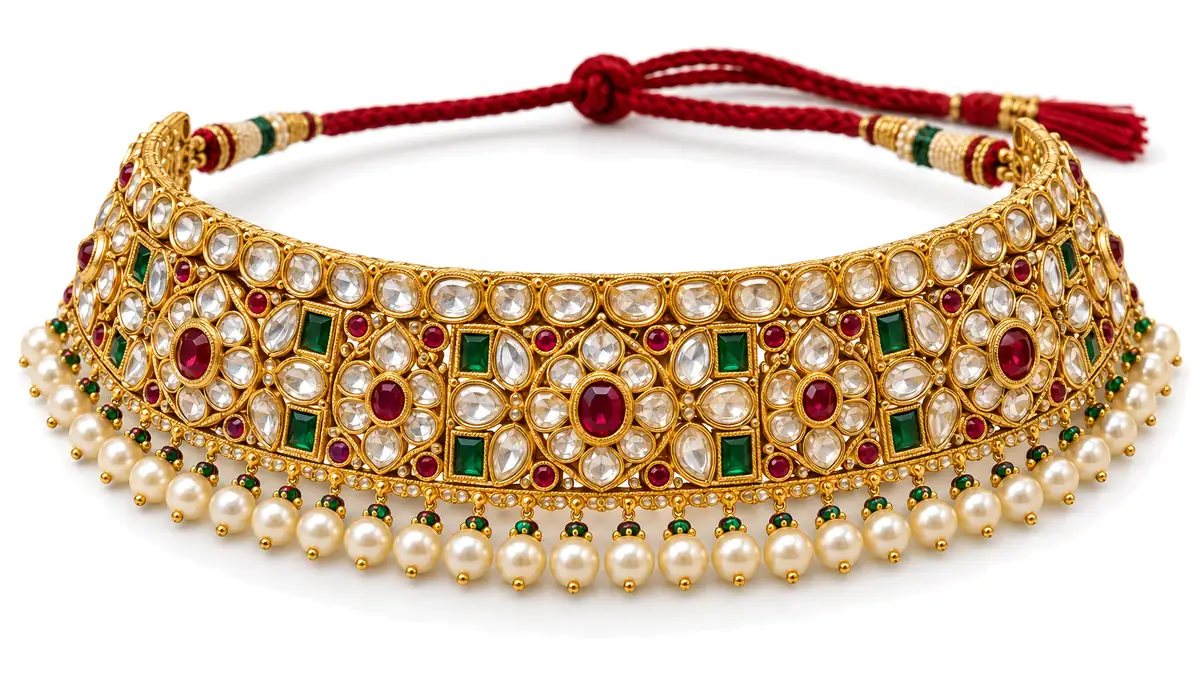
Key takeaways
- Kundan is the 24K gold foil collar that holds a stone — not the stone itself. The stones can be polki, rubies and emeralds, or glass.
- One piece passes through five specialists in a fixed order — designer, engraver, enameller, stone setter, stringer. A full bridal set takes about six weeks.
- Real kundan is hallmarked 22K gold with fired meenakari on the back. Market “kundan” is plated brass with glass, listed from about ₹200.
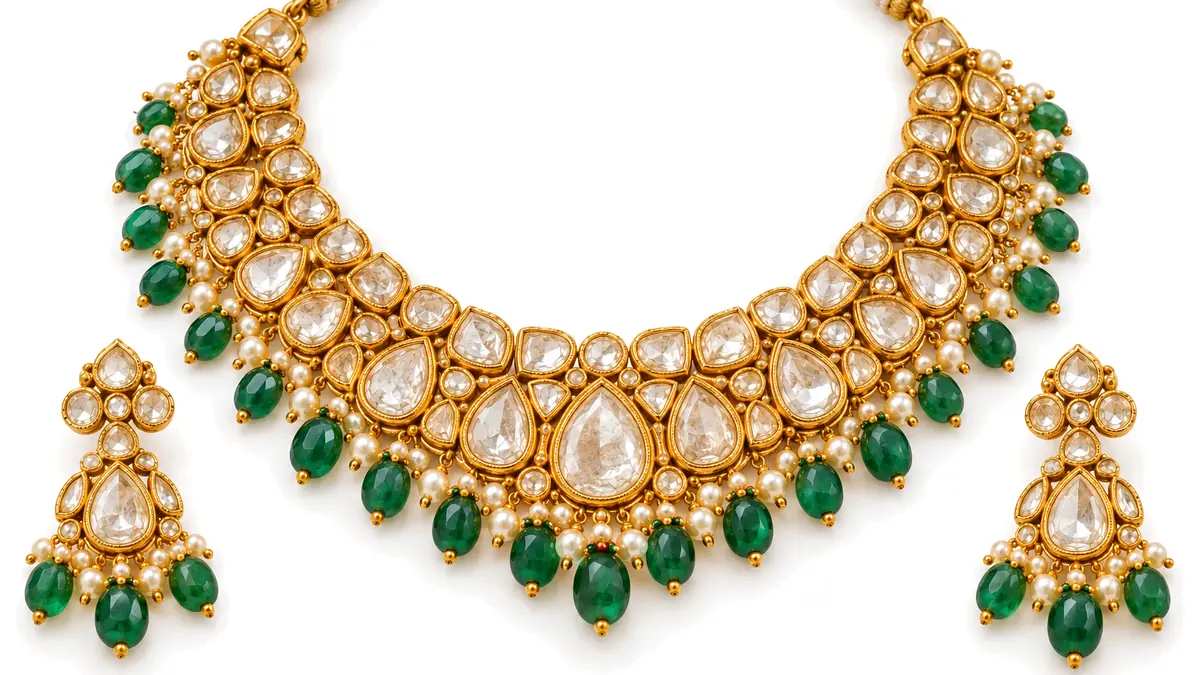
Kundan jewellery is jewellery in which every stone is held by a collar of 24-karat gold foil, pressed cold around its edge — no prongs, no claws, no solder. Kundan means pure gold, so the word names the setting, not the stone. The stones inside can be uncut diamonds (polki), rubies and emeralds, or glass.
What exactly is kundan jewellery?
Ask ten people what kundan is and most will point at a stone. It isn’t one. Kundanam means pure gold, and kundan is the oldest way of holding a stone in gold without a single prong: a strip of 24-karat gold, beaten thinner than paper, is pushed around the edge of the stone with a steel tool until the stone cannot move. No heat, no solder. That gold collar is the whole setting — and the whole meaning of the word.
Pure gold is soft enough to be worked cold, which is why it has to be 24 karat. Everything around it — the frame, the hollow under the stone, the enamel on the back — is a different material doing a different job. So when a shop says “kundan stones”, what it is really selling is glass or gemstones set by the kundan method, or, more often in the market, glass set to look like it.
Kundan, jadau and polki — three words, three jobs
- Kundan — the 24K gold foil collar that holds a stone. A technique.
- Polki — an uncut natural diamond. A stone. It is often set by the kundan method, which is why “kundan polki jewellery” is a common phrase. (See polki jewellery explained.)
- Jadau — from jad, to embed. The whole tradition: the gold frame, the lac core, the kundan setting and the meenakari fired onto the back. Kundan lives inside jadau; it is not a rival to it. That is why the biggest related search is “kundan jadau jewellery”.
Where kundan comes from: Mughal courts to Jaipur’s lanes
Kundan grew up at court. When Amber — the Kachhwaha kingdom that later built Jaipur — married into the Mughal court in the sixteenth century, Rajput goldsmithing met Persian and Central Asian gem-setting, and the two traditions started sharing a bench. Gem-set gold for emperors, queens and their horses was made this way for the next two centuries.
Two moves made Jaipur its home. In the 1590s Raja Man Singh of Amber brought enamellers from the Mughal workshops at Lahore and settled them here, so meenakari — the enamel on the back of every good kundan piece — stopped being an import and became a local trade. Then in 1727 Sawai Jai Singh II laid out a planned city with a street for each craft: Johari Bazaar, Gopalji ka Rasta, Haldiyon ka Rasta. Three hundred years later the same lanes hold the same work, and Jaipur is one of the world’s great coloured-stone cutting centres, so the stones arrive at the same door as the craft.
How kundan jewellery is made: five hands, in one fixed order
A kundan piece is not made by “a karigar”. It is made by a relay, and the order cannot change, because each step would destroy the one before it if they were swapped.
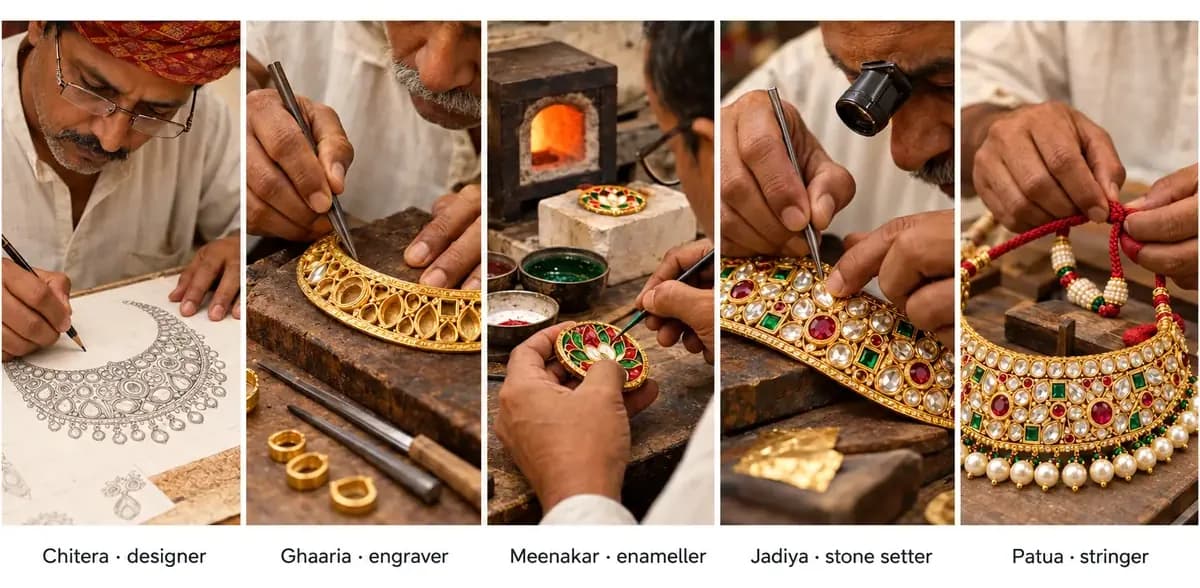
- The chitera (designer) draws the piece at full size on paper, stone by stone. Nothing is scaled up later — the drawing is the piece.
- The ghaaria (engraver) cuts the 22K gold sheet and carves one cavity for every stone, sized to a tenth of a millimetre. 22K, not 24K: pure gold is too soft to hold a shape at this scale.
- The meenakar (enameller) fills the back with mineral enamel and fires it, one colour at a time, hottest first — white, then green, blue, and red last. This has to happen now: the kiln would crack every stone.
- The jadiya (stone setter) pours warm lac into the hollows, beds each stone in it, then presses 24K kundan foil around its edge until it grips. Cold. No solder anywhere near the gems.
- The patua (stringer) knots the piece onto silk with the pearls and the adjustable back-cord — the last hand it passes through before yours.
Read that list again and the price of good kundan explains itself: four specialists and a kiln, in sequence, for weeks. A full bridal set in our workshop takes about six weeks.
Why red is always the last colour
Each enamel needs a different heat. White is the hardest and survives every firing after it, so it goes first and becomes the outline colour of almost every Jaipur piece. Red is the softest and the most precious — it only holds on gold and burns out on silver — so it is fired last, at the lowest heat. It is also the reason fine meenakari is a gold craft at all.
Inside a kundan setting, layer by layer
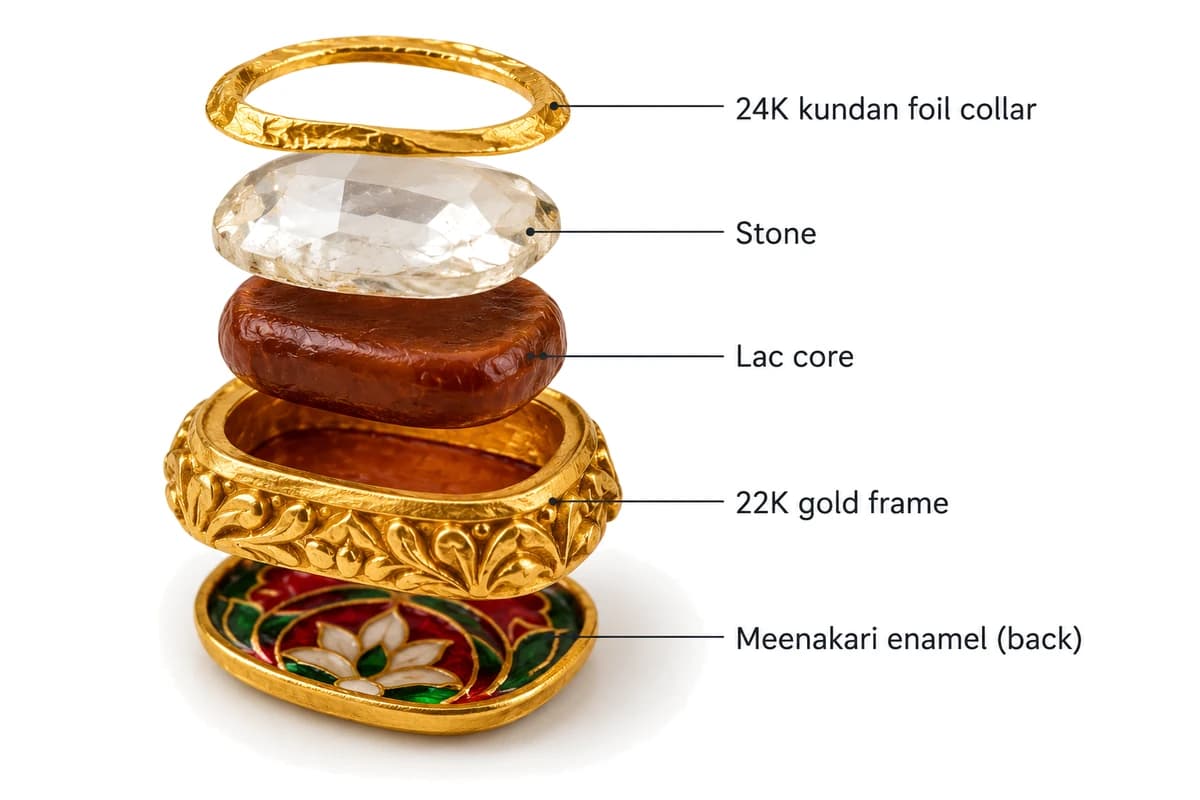
Every layer of a kundan setting is a different material, and each one is priced differently. Knowing them is the single best defence against being overcharged.
| Layer | What it is | What it means for the price |
|---|---|---|
| Meenakari (back) | Powdered glass fired into engraved channels | Labour, not metal — part of making |
| Gold frame | 22K gold, carved with one hollow per stone | The only part that follows the daily gold rate |
| Lac core | Warm shellac poured into the hollows | Real weight, zero metal value — should be charged at nothing |
| Stone | Polki, ruby, emerald — or glass | Priced separately; precious stones should come with paper |
| Kundan collar | Hair-thin 24K foil pressed around the stone | Tiny in weight; it is skill you are paying for |
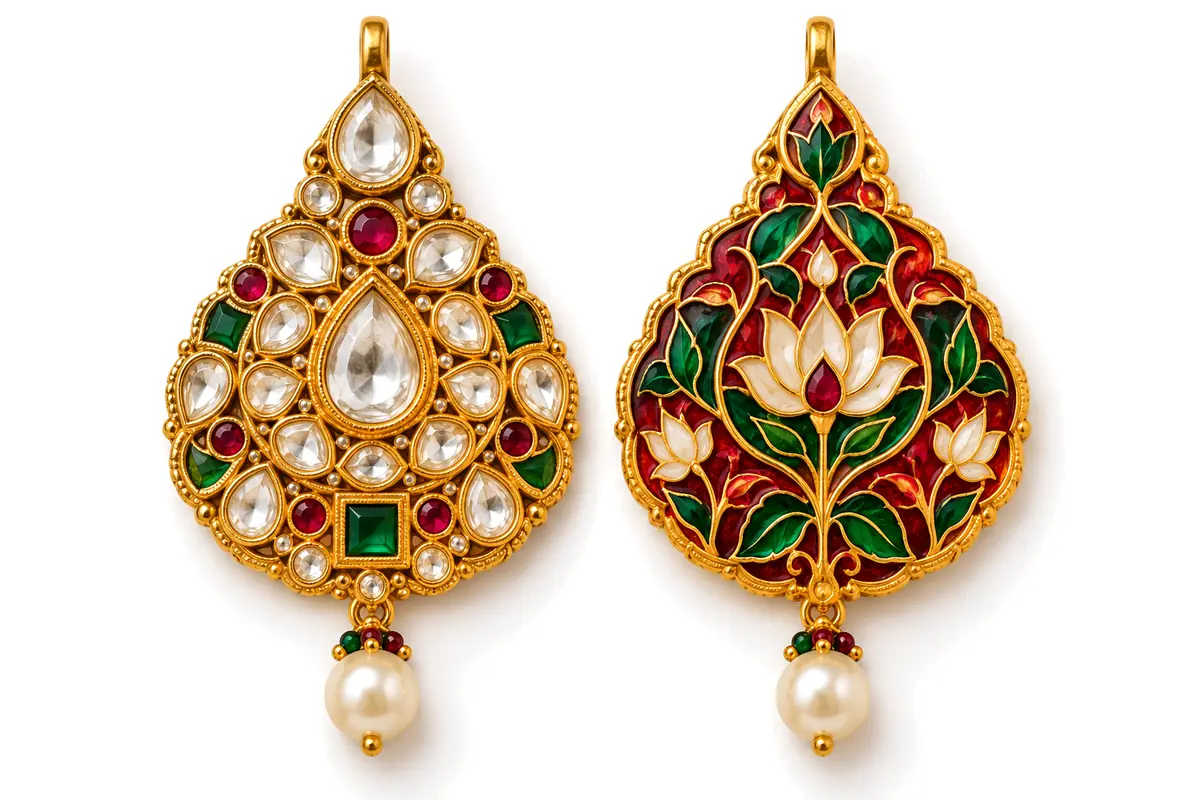
The lac is the trap. It fills the hollow under every stone to give the piece body and a soft bed, it weighs something on the scale, and it is not gold. A shop that weighs the whole piece and multiplies by the gold rate is charging you gold prices for shellac. We price it at zero and say so on the bill.
Why is kundan expensive? (And how much does real kundan cost?)
Real kundan is expensive for three reasons that stack: it is made of gold, it is made by hand by several specialists, and the good pieces carry precious stones. Market kundan is cheap for the opposite three reasons.
The honest way to price a gold kundan piece is to break it into lines:
- Net gold weight × today’s 22K rate. Net means after the stones and the lac are taken out. Check today’s 22ct gold price.
- Stones, priced on their own — polki per carat, coloured stones per piece or carat, glass at very little.
- Making (kaarigari) — the five hands and the kiln. For jadau work this is the part you are really buying heritage for, and it is higher than for a machine-made chain.
- Hallmarking — a small per-piece BIS fee.
- GST at 3%, on the whole invoice.
As a worked example: at about ₹13,500 a gram for 22K gold (mid-October 2026), a choker with 30 g of net gold carries roughly ₹4 lakh of gold before a single stone or hour of work is added. That is why real kundan bridal necklaces usually run into lakhs, while “kundan sets” on marketplaces list from about ₹200 to ₹20,000 — those are gold-plated brass or copper with glass.
Gold kundan vs market kundan
Both are sold as “kundan jewellery”. They are different products, and only one of them is gold.
| Gold kundan (jadau) | Market kundan | |
|---|---|---|
| Metal | 22K gold frame, 24K kundan foil | Brass or copper, gold-plated |
| Stones | Polki, rubies, emeralds — or good glass | Glass or CZ |
| Back | Fired meenakari enamel | Paint, foil sticker or plain metal |
| Hallmark | BIS hallmark with a 6-digit HUID | None |
| Price basis | Gold weight + stones + making | Fixed retail price |
| Life | Generations; can be reset and restrung | Plating wears; usually replaced |
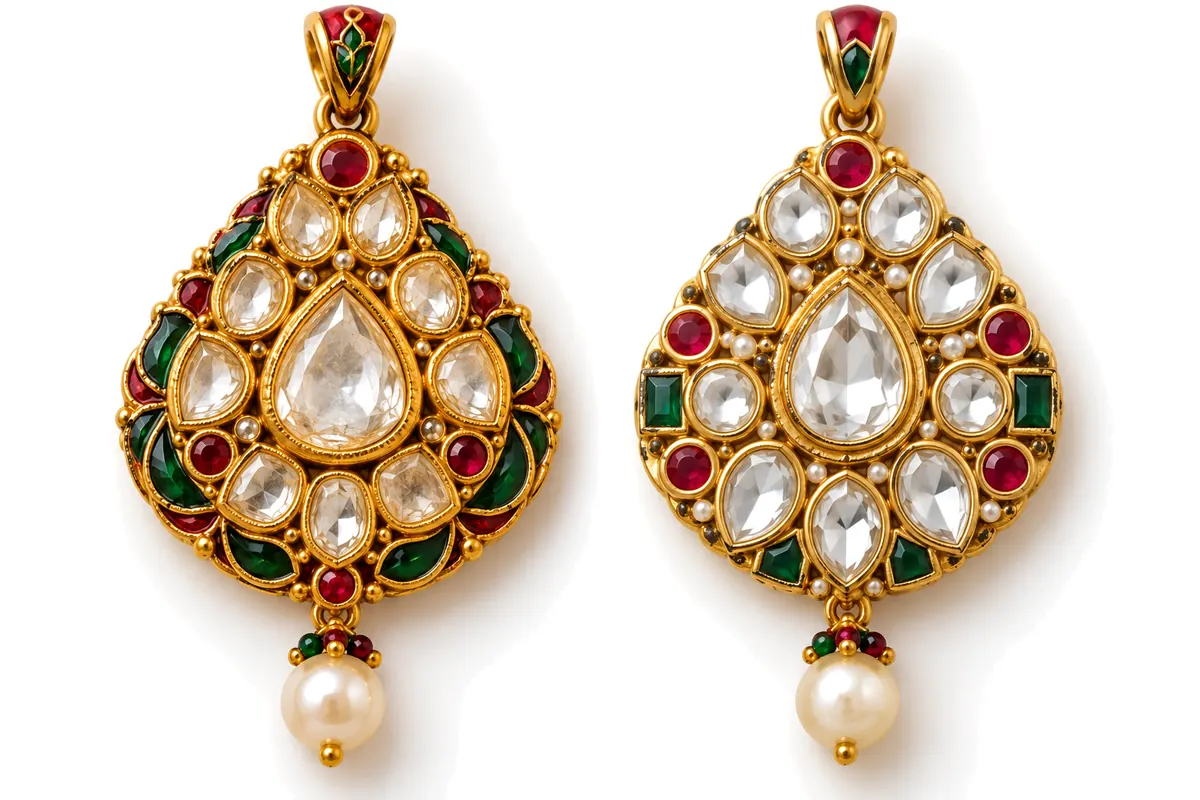
Market kundan is not a scam — it is costume jewellery, and it is perfectly good for a sangeet. The problem only starts when the two are priced or described as one another.
How to identify real kundan jewellery: 7 checks
- Find the hallmark. Gold jewellery in India carries the BIS mark, the purity (22K916) and a 6-digit HUID. No hallmark, no gold claim.
- Ask for net and gross weight. Gross is the whole piece; net is gold only. A seller who cannot give you both is weighing the lac as gold.
- Turn it over. Fired meenakari looks like glass, sits in cells with thin gold walls between colours, and does not scratch with a fingernail. Paint looks flat and chips.
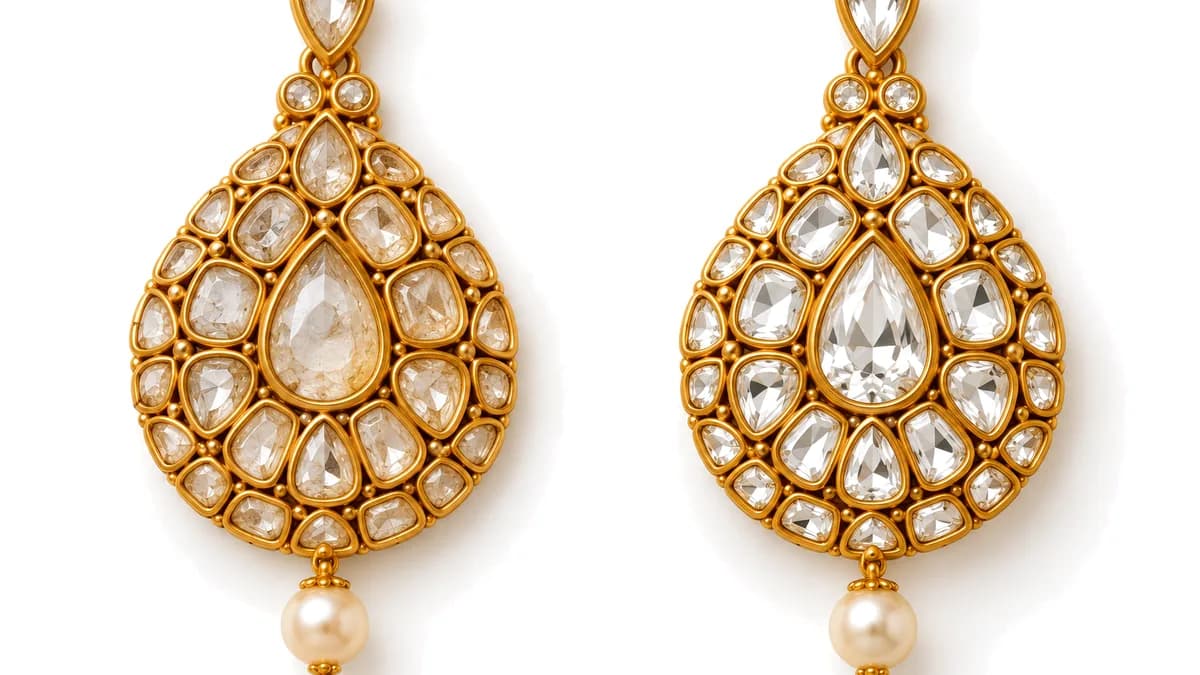
- Look at the collar. Hand-pressed kundan foil is bright, slightly uneven and hugs each stone’s own outline. A cast or stamped rim is perfectly regular.
- Ask what the stones are — in writing. “Kundan” says nothing about the stone. Polki, rubies and emeralds should be named on the bill, ideally with a lab report.
- Check the cord. Good pieces are strung on silk with an adjustable back-cord (the patua’s work), not on chain with a lobster clasp.
- Read the invoice. Gold, stones, making, hallmarking and GST should be separate lines, with the lac at zero.
Kundan bridal jewellery: what a full set includes
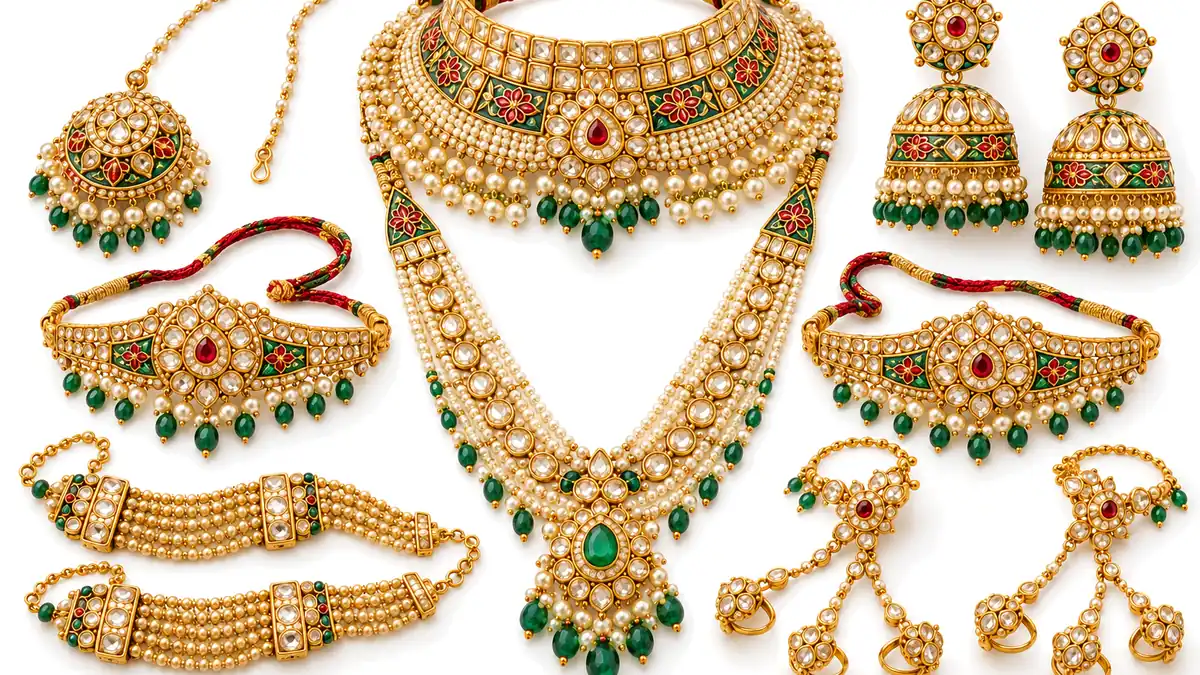
A Rajasthani kundan bridal set is not a necklace and earrings; it is a head-to-wrist system, and each piece has a name and a place. The core of it is the aad — the broad plate choker — with a rani haar layered below, karanphool jhumkas, a borla or maang tikka, and at the wrists a ponchi and bajuband. We list all twenty pieces, with pictures, in Rajasthani jewellery names.
If you are building a set over time, start with the piece that carries the most gold and the most meaning — usually the aad — and add the smaller pieces around it.
Caring for kundan jewellery
- Keep it dry. Water, perfume and hairspray work their way under the foil and dull the stones from behind. Put the jewellery on last and take it off first.
- Keep it cool. Lac softens with heat. Never leave kundan in a car or near a stove, and never use an ultrasonic or steam cleaner.
- Store it flat. Wrap each piece separately in soft cotton or butter paper, in a box, so stones do not rub against each other.
- Wipe, don’t wash. A soft dry cloth after every wear is all it needs.
- Restring, don’t replace. When the silk cord frays, a patua can restring the piece in a day; the gold work underneath lasts generations.
Questions people ask
What exactly is kundan jewellery?
Kundan jewellery is jewellery in which each stone is held by a collar of 24-karat gold foil pressed cold around its edge, with no prongs or solder. Kundan means pure gold, so the word describes the setting, not the stone.
Is kundan always set in gold?
It can be either. Traditional kundan (jadau) is made in a 22K gold frame with a 24K gold kundan collar and carries a BIS hallmark. Most kundan sold cheaply in the market is gold-plated brass or copper with glass stones.
Why is kundan jewellery expensive?
Real kundan is made of gold, made by hand by about five specialists over several weeks, and often set with precious stones such as polki, rubies and emeralds. Each of those is priced separately on an honest invoice.
What is the difference between kundan and jadau?
Kundan is the 24K gold foil that holds a stone. Jadau is the whole craft around it: the gold frame, the lac core, the kundan setting and the meenakari on the back.
Can kundan jewellery be worn every day?
It is made for occasions. Daily wear exposes it to water, sweat and heat, which loosen the foil and soften the lac. Lighter kundan earrings or a pendant can be worn often if they are kept dry.