Buying guide
Difference Between Polki and Kundan: 7 Clear Signs
Polki is a stone; kundan is a setting — so a piece can be both. Seven things you can check in the shop, what each costs, and which one to choose.
By Ponchi by MK Jewellers, Jaipur8 min read
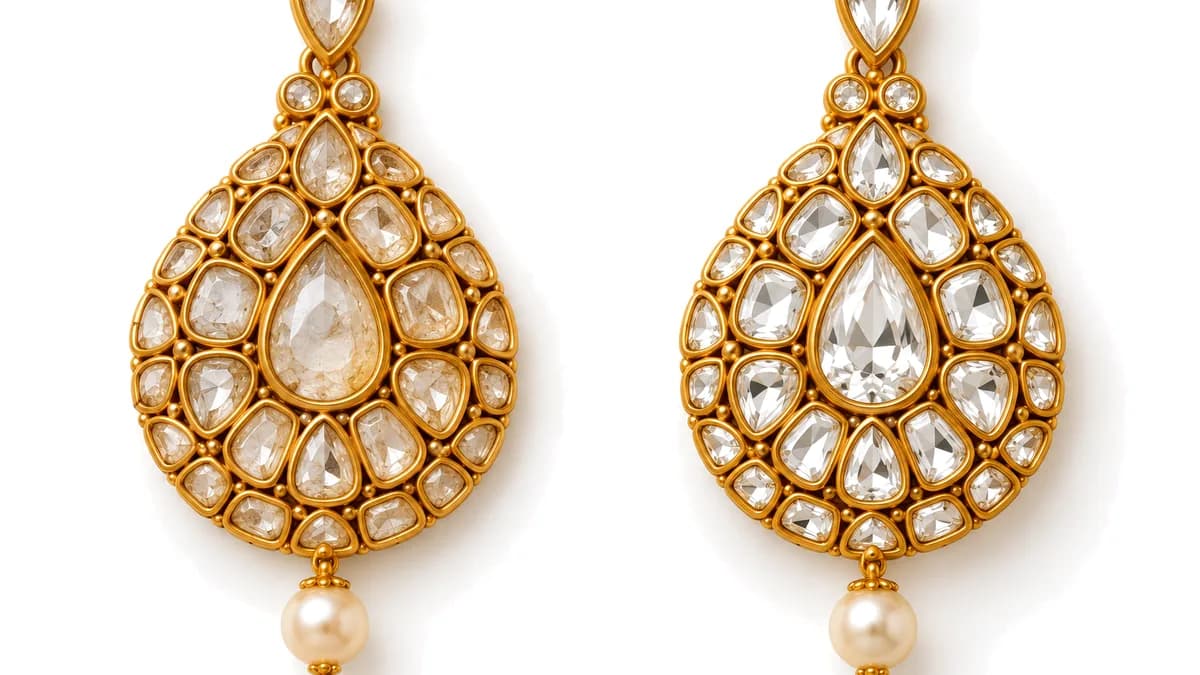
Key takeaways
- Polki is a stone (an uncut natural diamond); kundan is a setting (24K gold foil). One piece can be both: polki set in kundan.
- Seven checks tell them apart: the stone, the light, the outline, a 10× loupe, the paperwork, the price structure and the resale value.
- Polki costs more because it is diamond priced per carat; gold kundan with glass is priced on its gold and making.
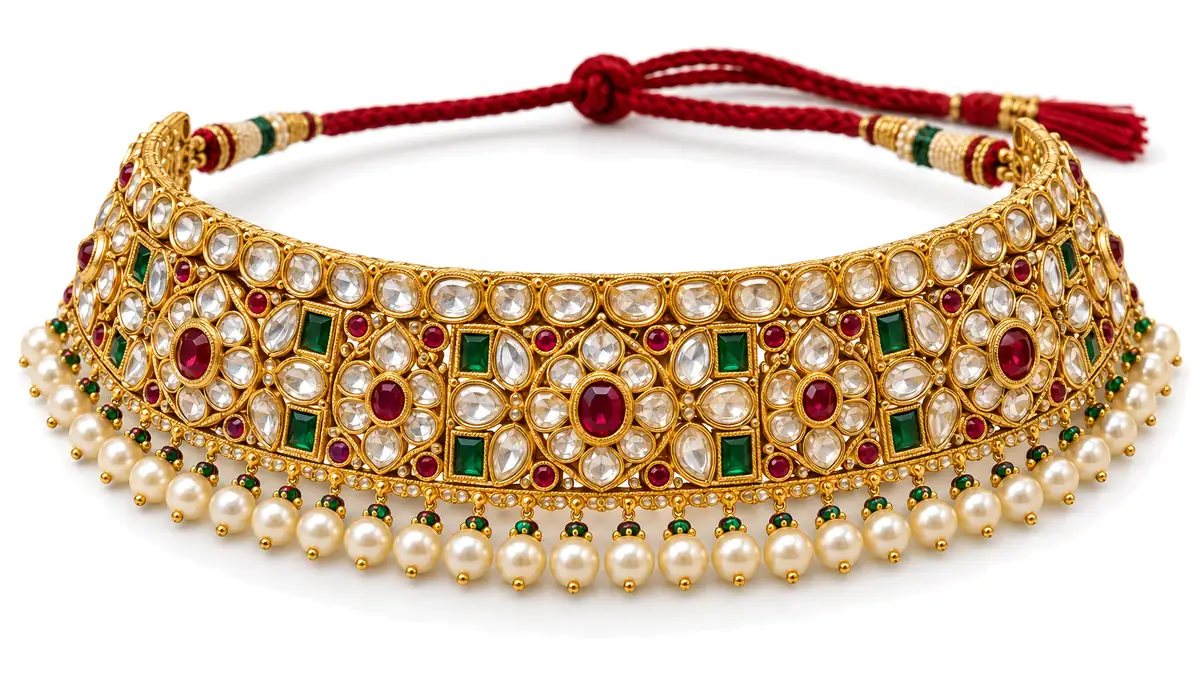
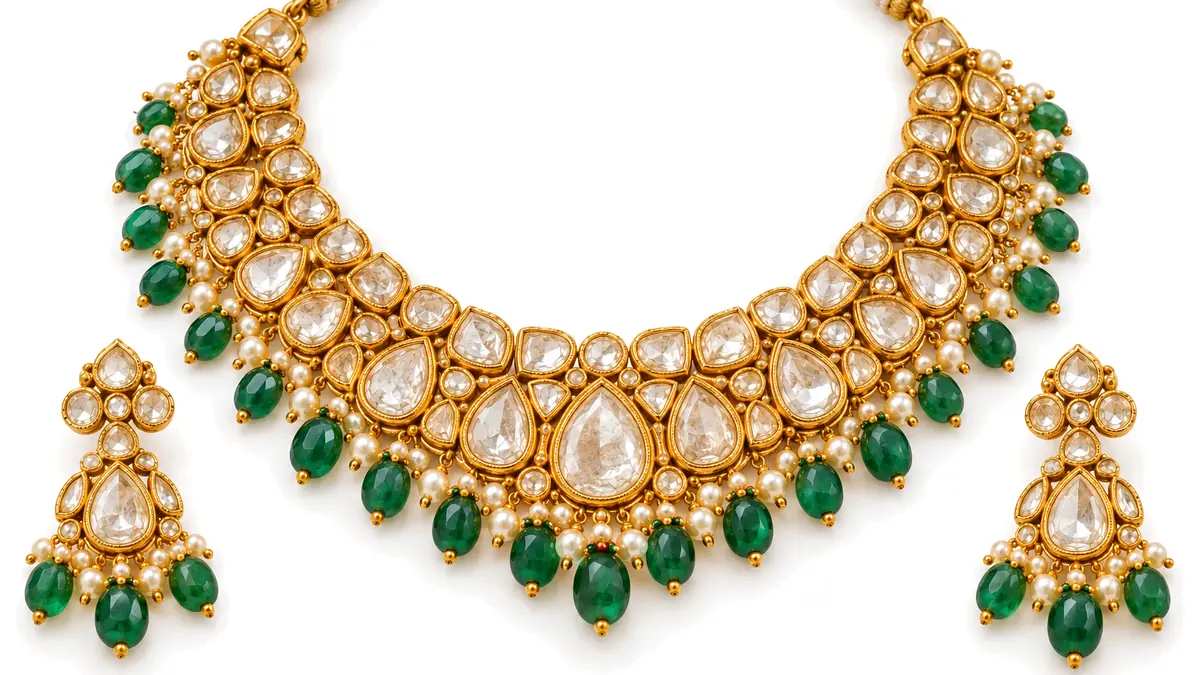
The difference between polki and kundan is that polki is a stone and kundan is a setting. Polki is an uncut natural diamond. Kundan is the 24-karat gold foil pressed around a stone to hold it — and that stone can be a polki, a ruby, or glass. So a piece can be both: polki set by the kundan method. Polki costs more because it is diamond.
Polki vs kundan in one minute
| Polki | Kundan | |
|---|---|---|
| What it is | A stone: an uncut natural diamond | A setting: 24K gold foil around a stone |
| The stone | Always diamond | Polki, ruby, emerald — or glass |
| Look | Soft glow, irregular outlines | Glass: even shine, uniform shapes |
| Sold by | Carat weight + gold + making | Gold + making (if gold at all) |
| Paperwork | Carat weight, lab report | Usually none for the stones |
| Price | Higher | Lower — market kundan is costume |
| Resale | Gold, plus diamonds per buyback terms | Gold only (or nothing, if plated) |
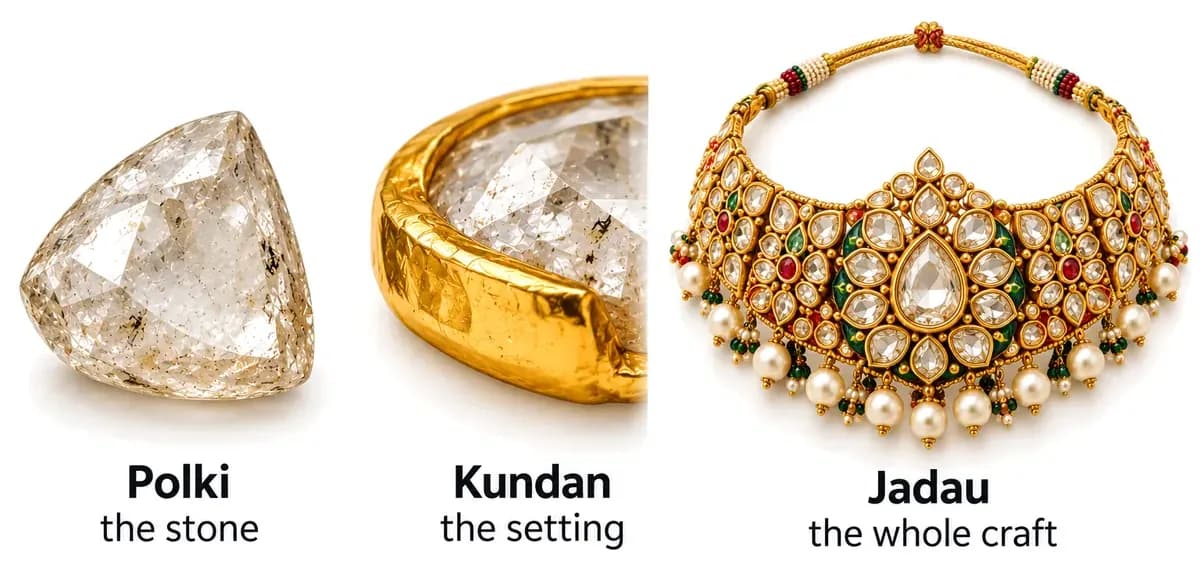
Most of the confusion comes from one word doing two jobs. In a jewellery workshop, kundan is the gold foil collar — a technique. In a shop window, “kundan” has come to mean glass-set jewellery made to look like the old work. Polki never had that problem: it has only ever meant diamond. (For the full story of each, read kundan jewellery and polki jewellery.)
Sign 1: Ask what the stone is
This is the one question that settles it. “Polki” answers it on its own — it is diamond. “Kundan” doesn’t: it tells you how the stone is held, not what it is. So ask the seller to name the stone and write it on the bill. If the answer is “kundan stone”, the stone is glass.
Sign 2: Look at the light
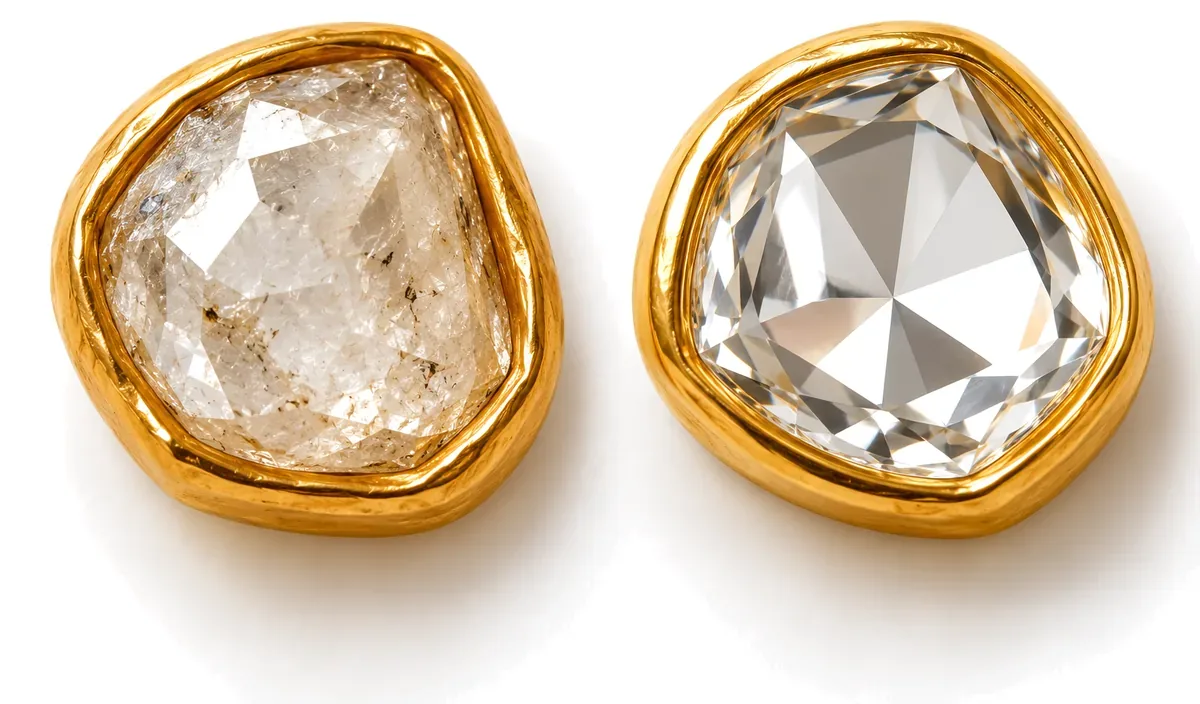
Hold the piece under a single light and tilt it. Polki glows: the light seems to come from inside, a little milky or warm, and every stone looks slightly different. Glass shines on its surface, evenly, and every stone looks the same. A polki set that looks too perfect deserves a second look.
Sign 3: Look at the outline of each stone
Polki keeps the shape the diamond split into, so outlines are irregular — a slightly lopsided oval here, a soft-cornered square there — and the kundan foil is pressed to follow each one. Glass for kundan is moulded or cut to calibrated sizes, so the stones are uniform and line up perfectly.
Sign 4: Use a loupe — inclusions vs bubbles
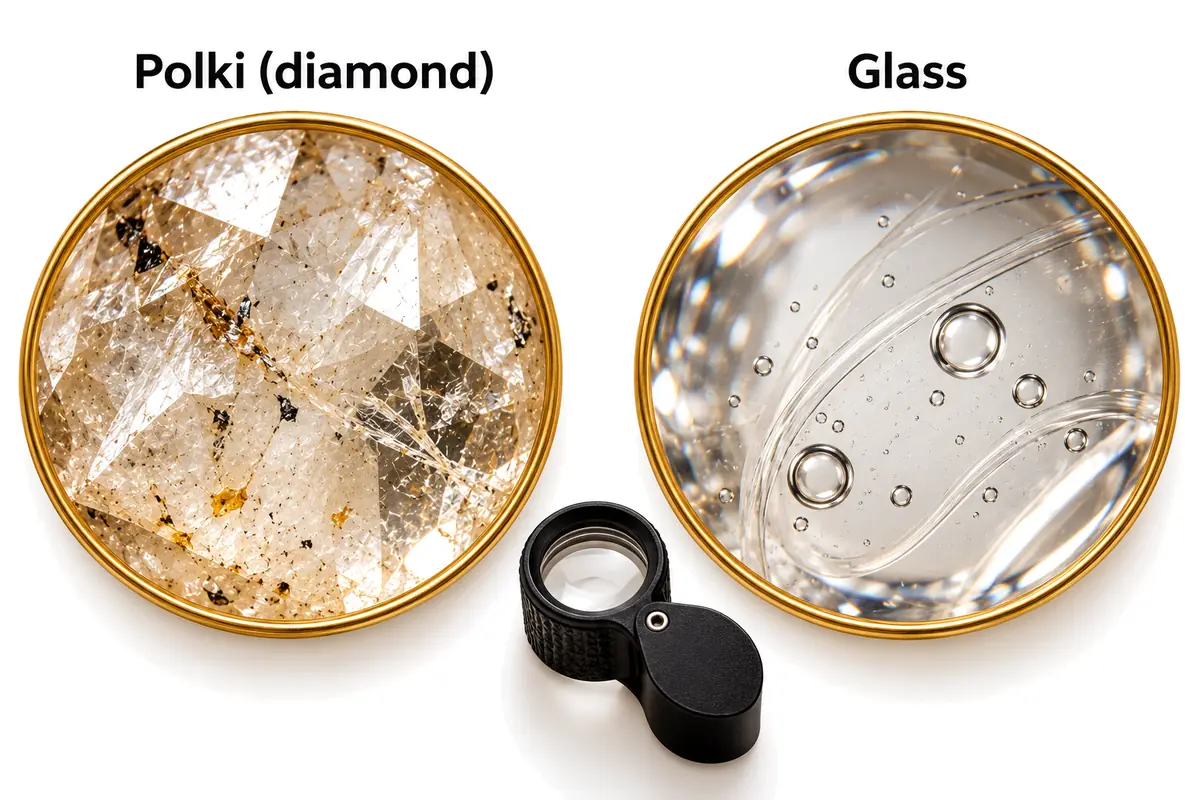
A 10× jeweller’s loupe costs a few hundred rupees and answers more questions than any sales pitch. Inside a natural diamond you will see crystal inclusions — tiny dark or white flecks, feathers, angular shapes. Inside glass you will see round gas bubbles and swirl lines from the melt. Round bubbles are never in a diamond.
Sign 5: Ask for the paperwork
Real polki is weighed and sold by the carat, so the bill should show the total diamond weight — and a precious piece should come with a lab report. Gold kundan with glass stones has nothing to certify except the gold, which carries a BIS hallmark and a 6-digit HUID. Market kundan has no hallmark at all.
Sign 6: Read how it is priced
A polki quote has a diamond line. A kundan quote usually doesn’t. In both, the gold should be charged on net weight, after the stones and the lac core are taken out — the lac is shellac, worth nothing per gram, and it should never be charged at the gold rate.
Is polki more expensive than kundan?
Yes, almost always, because polki is diamond and kundan is a gold setting that may hold glass. A gold kundan necklace with glass stones is priced mostly on its gold and making; the same necklace in polki adds the diamonds on top. Market kundan, in plated brass, is cheaper than either.
Is kundan costlier than gold?
Gold kundan costs more than plain gold of the same weight, because of the handwork — about five specialists and a kiln over several weeks. Plated market kundan costs far less than gold, because it isn’t gold.
Sign 7: Ask what it is worth when you sell it
Ask the buyback question before you buy. For any gold piece, the gold has resale value. For polki, the diamonds may be valued too — depending on the jeweller’s buyback terms, which you should get in writing. Glass has no resale value, and plated kundan has none at all.
What polki and kundan have in common: jadau
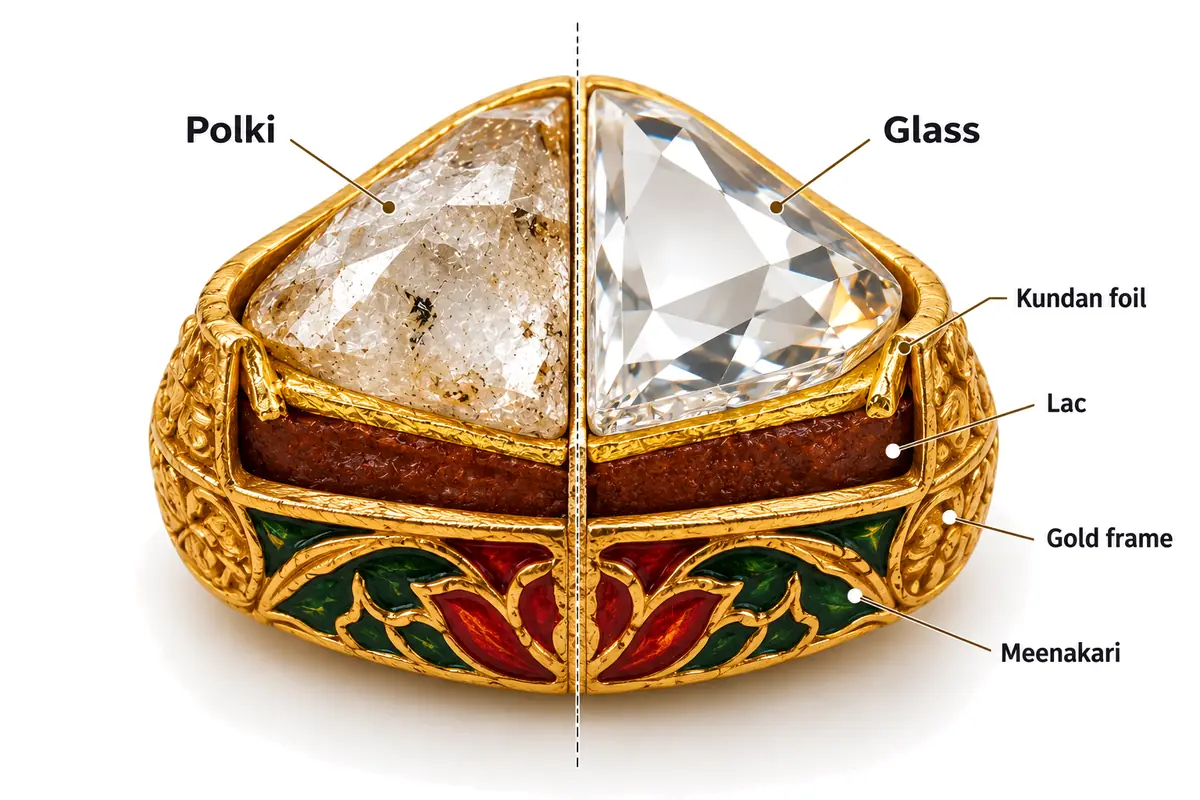
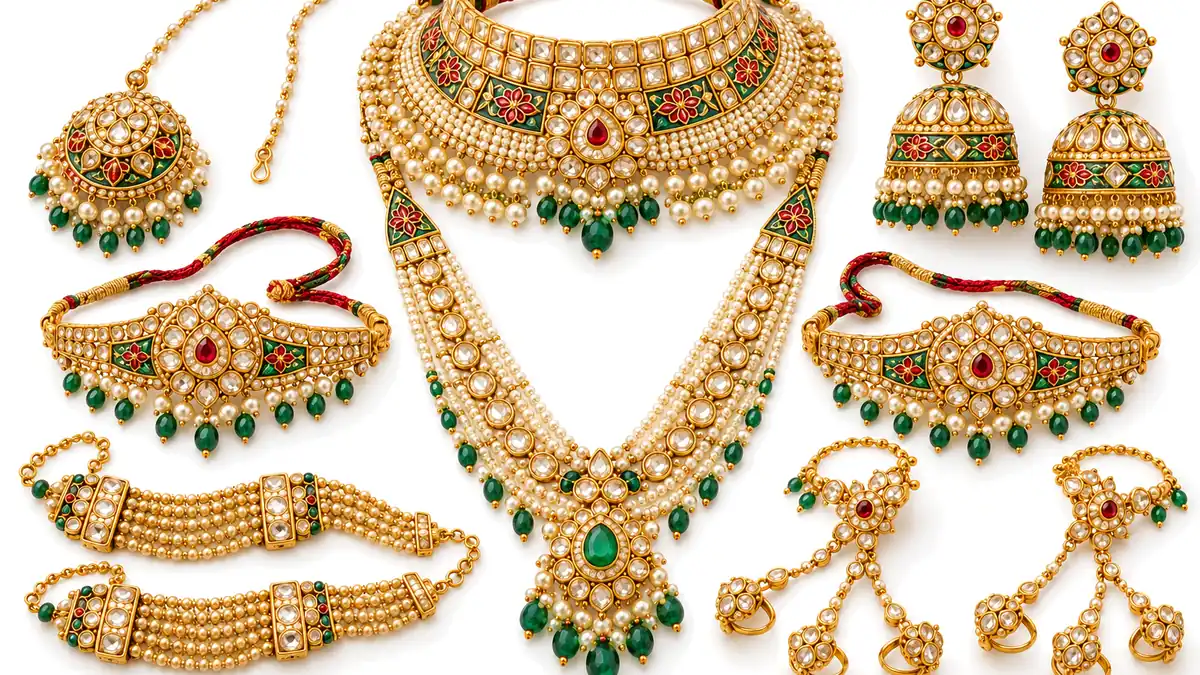
Here is the part most comparisons get wrong: the setting method is the same. In fine jadau work, a carved 22K gold frame is enamelled on the back, filled with warm lac, and every stone — polki or glass — is bedded into the lac and gripped by a 24K kundan collar. That is why “kundan polki jewellery” is a real thing, and why turning a piece over to look at the meenakari won’t tell you which stone is on the front.
4 myths about polki and kundan
Myth 1: “Kundan is a kind of stone.”
Kundan is the gold, not the stone. A “kundan stone” in a shop is glass cut and foiled to look like the old work; a stone set in kundan can be anything from glass to a polki diamond.
Myth 2: “You can tell them apart from the back.”
You can’t. Fine polki and fine kundan pieces share the same frame, the same lac and the same fired meenakari on the reverse. The back tells you whether the work is good jadau — not which stone is on the front.
Myth 3: “Polki is a fake or low-grade diamond.”
Polki is a natural diamond, graded like any other: some is milky and included, some is clean and white. A large, clean polki is rarer than a cut diamond of the same weight, because most rough that clean is sent away to be faceted.
Myth 4: “Kundan jewellery is always cheap.”
Only plated kundan is. A 22K gold kundan set with rubies, emeralds and pearls is priced on its gold and stones like any fine jewellery, and can cost as much as a diamond set. Cheap “kundan” is costume — sold honestly, it is fine.
Polki and kundan for daily wear
Neither was designed for the office, but both can be worn often if you choose the right pieces. Polki is diamond, so a polki kada or a pair of polki studs takes daily wear well — keep it dry and off when you wash your hands. With kundan, choose light earrings or a small pendant over a necklace: the lac and foil dislike sweat and water, and smaller pieces see less of both.
Which is better, kundan or polki?
| If you want… | Choose | Why |
|---|---|---|
| An heirloom bridal set | Polki (in kundan) | Diamonds hold value and the set can be reset for the next bride |
| The Rajputi look on a budget | Gold kundan with glass | Same craft and silhouette, far lower stone cost |
| Something for one function | Market kundan | Costume price; no gold, no resale |
| A piece to wear often | Polki kada or studs | Diamond is hard-wearing; keep it dry |
| Colour more than sparkle | Kundan with rubies or emeralds | Coloured stones read from further away |
Neither is better in the abstract. Polki is the more valuable material; kundan is the craft that makes polki wearable. The right question is how long you want the piece to last, and what you want to be able to do with it later.
How to identify polki jewellery: a 60-second shop check
- Ask: “What is the stone, and what is the total carat weight?”
- Tilt it under one light: glow and variety, or even shine and sameness?
- Look at the outlines: irregular, or calibrated?
- Put a loupe on the biggest stone: inclusions, or bubbles?
- Find the hallmark and the HUID on the gold.
- Ask for net gold weight, with the lac excluded.
- Ask for the buyback terms in writing.
Shopping for either? See our polki bracelets or kundan chokers, or bring any piece — ours or not — to our Jaipur shop and we will tell you what it is.
Questions people ask
What is the difference between polki and kundan?
Polki is a stone — an uncut natural diamond. Kundan is a setting — 24K gold foil pressed around a stone to hold it. The stone in a kundan setting can be polki, a coloured gemstone or glass.
Which is better, kundan or polki?
Polki is the more valuable material because it is diamond; kundan is the technique that holds it. For an heirloom choose polki set in kundan; for the same look on a budget choose gold kundan with glass.
Is polki more expensive than kundan?
Yes, almost always. Polki is priced per carat as diamond on top of the gold and making, while kundan with glass is priced mostly on its gold and making.
Is kundan costlier than gold?
Gold kundan costs more than plain gold of the same weight because of the handwork. Market kundan, which is gold-plated brass or copper, costs much less than gold.
Can a piece be both kundan and polki?
Yes. Most fine bridal jadau is polki set by the kundan method — which is why the phrase kundan polki jewellery exists.